

UPDATED – School Year 2025- 2026!
New evidence-based curricula added to the ranking!
Do you feel overwhelmed trying to choose the right phonics program for your child or student?
You’re not alone — and you’re in the right place.
This updated ranking of the best phonics curricula for 2025–2026 breaks down 10 high-quality, research-based synthetic phonics programs that actually teach children how to read.
While all of these programs are solid options, not every curriculum is right for every child. Some work best for very young learners, others for struggling or dyslexic readers, and some are ideal for busy families who need clear guidance with minimal prep.
By the end of this article, you’ll know:
- What truly separates strong phonics programs from weak ones
- Which curriculum fits your child’s learning style
- Which programs are best for struggling readers, homeschoolers, or busy parents
*Affiliate Disclosure: Some links lead to Amazon marketplace. As an Amazon associate, I earn from qualifying purchases, at no additional cost to you. This helps keep the information on the blog free and available to everyone. There may be other affiliate links on the article.
A Quick Note on Methodology (and Where I Stand)
There’s a lot of noise around phonics vs. whole word or balanced literacy.
I ’ll be very clear, and tell you upfront where I stand regarding this debate. I truly believe that phonics is the best approach for teaching children to read. Therefore:
- All programs on this list are phonics-based
- All align with what modern reading science tells us about how the brain works and how we learn to read.
This is not opinion — it’s supported by decades of research on how the brain learns to read.
More specifically, the programs below are systematic, explicit, synthetic phonics curricula, because those consistently produce the strongest reading outcomes.
What Makes a Strong Phonics Program? My criteria
Not all phonics programs are created equal.
The best ones:
- Teach phonemic awareness explicitly
- Follow a clear, cumulative sequence
- Avoid guessing, memorization, and leveled-text shortcuts
- Provide enough practice to build automaticity
- Are transparent and predictable for parents
That’s the lens I used to create this ranking.
I am also aware that different children need different approaches and methodologies. Some kids benefit greatly from a multi-sensory learning approach, while others may require very explicit and structured lessons, along with plenty of practice opportunities. Some parents just want clear guidance and low-prep, while other families appreciate having some flexibility, and don’t mind the extra preparation.
That’s why I’ve also shortlisted programs with different teaching and learning styles.
By the way, if you are confused by the terminology, don’t worry!
You can check out this article, where I explain more in detail what synthetic phonics is.
Or this article, where I explain the differences between analytic and synthetic phonics.
So, without further ado, let’s get started with the list!
IMPORTANT!
This article contains a lot information. If it is too much information all at once, you can of course re-read the article as many times as you like!
However, you can also download the notes from the article here!
Even though I’ve done extensive research on this topic, there may be programs I’m not aware of—there are just so many! This is exactly what motivated me to write this article!
| Program Name | How to buy? | Who is it for? | System Used | Levels | Great if you want... | Reading & Spelling? | What is the price? | Guarantee |
|---|---|---|---|---|---|---|---|---|
| Children Learning Reading | From the Children Learning Reading Website! | Great for young readers and for reinforcing reading instruction at home, if your child goes to school. | Unique system that combines Phonemic Awareness and Synthetic Phonics | Only 1. Everything is included in this one level. | Simple and short lessons, convenient implementation (Doesn’t get messy!) | Reading instruction only, spelling / writing not covered specifically. | $39.00 - $89.00 | 30-day money-back guarantee. |
| All About Reading | From their website! | Great for children that learn best through multi-sensory experiences. Very popular homeschooling curriculum. | Orton-Gillingham. | 5 Reading Levels + 7 Spelling Levels (All About Spelling) | A multi-sensory program and very explicit instruction. Very good option for homeschooling, and for children with reading difficulties. | Tackles spelling and reading separately. | Each Level is $149 + one-off purchase of interactive kit ($45.85 -$21.85). | Full 1-year money- back guarantee |
| Logic of English | From their website! | For children that learn through multi-sensory experiences, and children with dyslexia or other reading difficulties. Another popular homeschooling curriculum. | Orton-Gillingham. | Their Essential Package includes 3 Reading Levels (a, b, c). | A multi-sensory program, that also goes really deep into rules (into the ‘logic of English’). | Tackles spelling, writing and reading all together. Another very popular curriculum for home schooling. | Foundations Module: From $74.99 (per level). Whole Essential Package: $159.99 - $279.99 | 90- day money-back guarantee. |
| Hooked on Phonics | From their website! | For children that thrive on a very clear routine when it comes to learning, and appreciate the use of audio-visuals elements (video lessons). | Sequential, systematic synthetic phonics approach. | 8 Reading Levels. You can complement reading instruction with their app for an even more complete curriculum. | A very simple, but fun approach that uses audio-visuals elements (video lessons, app) . Very good for busy parents! The hard work is done for you! | Tackles reading and spelling. However, an additional spelling practice pack can be purchased for further practice. | Complete Learn to Read Kit (all levels): $209 | 30-day money-back guarantee. |
| Reading.com | Try Free Here! | Beginning readers. Takes children from basic letter recognition skills to approx. 2nd grade reading level. | Based on solid synthetic phonics principles and the Direct Instruction method to teaching reading. | 1 (all in one app!) | A digital curriculum with super convenient implementation. | Only reading. | Free trial. After that, only $6.25 a month (yearly subscription) or $12.49/month (monthly subscription). | Cancel anytime. No lock-in contract. |
| Funnix | From Funnix Website. | Children who need very explicit instruction, lots of repetition, and ongoing review to make sure skills truly stick before new material is introduced. | Direct Instruction (DI) model to Teaching Reading. | 2 (Funnix Beginning Reading, and Funnix 2) | A no-nonsense, teacher-style program with step-by-step instruction. | Only reading. | From $24.99/month. Special $14.99/month exclusive discount here for our readers. | Cancel anytime with monthly subscription. |
| Reading Horizons | From their website. | Struggling readers, dyslexic students, logical/analytical thinkers, older and intervention students. | Orton-Gillingham + analytical principles (unique marking system). | 2: Discovery (K-3) and Elevate (4-12 and adults). | Intervention-style instruction. A method for logical and highly analytical students. | Reading + spelling | From $199 per year. $10 trial here | 60-day money back guarantee |
| Phonics Pathways | Buy Phonics Pathways on Amazon! | Struggling readers, students that find blending particularly difficult, or students with learning disabilities, such us dyslexia. | Systematic synthetic phonics in combination with the successive blending approach. | 1 (everything included in 1 single manual) | The best option we know of if you want to try successive blending. | Reading + spelling appendix. | Very affordable. Approx. $20. Check final price on Amazon. | Amazon T&C's. |
| Teach Your Child to Read in 100 Easy Lessons | Teach Your Child to Read in 100 Easy Lessons on Amazon! | Great program to teach any child to read from scratch in a one-to-one setting (direct instruction). | DISTAR System (Direct Instructional System for Teaching and Remediation). | Only 1. Everything included in 1 manual! | To be taken by the hand following a script, and following a system that has been proven to work. | Only reading. | Very affordable. Normally sold for less than $20. Check final price on Amazon! | Amazon T&C's. |
| Alpha Phonics | Buy Alpha Phonics on Amazon! | For anyone looking for a no-frills phonics-based system. | Phonics Primer. Uses synthetic phonics principles. | 1 (everything included in 1 manual) | Simple / no-frills program that is easy to follow and implement. | Only reading | Very affordable. Normally less $20. Check final price on Amazon. | Amazon T&C's. |
You may also be interested in taking our Quiz to Find out the Best Literacy Curriculum… for YOU!
Reading Program #1: Children Learning Reading
IN A NUTSHELL
Best for: Very young learners & simple daily lessons. Ideal for reinforcing reading skills at home.
Approach: Synthetic Phonics, with a strong focus on the development of Phonemic Awareness skills.
Guarantee: 30-day money-back
Format: Access digitally (printable materials)
Levels: 2 stages (all included in one single purchase)
Best if you want: Ultra-short lessons (2–20 min), convenient implementation
Covers: Reading only
Price: $39–$89.
How to Buy: From the Children Learning Reading Website
BONUS
This program has allowed me to share with you a sample of their Phonemic Awareness/Phonics worksheets.
You can get them from here!
*NOTE: Should you decide to buy this curriculum, bear in mind that these worksheets are offered as an additional one-off purchase. You can still do the program without them, but they are a nice complement to the rest of their learn-to-read materials.
If you know me, it’s no secret that I have a soft spot for this program.
I used it with my older daughter, and her progress was genuinely impressive — especially because the program is so simple on the surface.
What makes it powerful is the sequence and the daily consistency it creates.
This is also one of the reasons it works well for young kids: you’re not trying to force long lessons when their attention span is still developing. Instead, you build reading ability gradually through small wins that add up.
What does “Phonemic Awareness + Synthetic Phonics” actually mean?
Let’s make the terminology simple.
Phonemic awareness = your child’s ability to hear and work with the smallest sounds in words (phonemes).
For example, in the word cat, a child with phonemic awareness can:
- Hear that it has three sounds: /k/ /a/ /t/
- Take one sound away and notice changes (cat → at)
- Swap sounds to make new words (cat → mat)
This skill is a huge predictor of reading success because it helps children understand that words are made of sounds — and that letters represent those sounds.
Synthetic phonics = teaching children to read by learning letter-sound correspondences and then blending sounds together to read words.
How the Program Works
The program is designed in two stages:
- Stage 1 (Foundational): very beginner-friendly, designed to build strong early decoding skills.
- Stage 2 (Advanced): expands into more complex spelling patterns and sound-symbol knowledge.
The daily lessons are short — usually anywhere from 2 minutes (yes, really) up to around 20 minutes, depending on where your child is in the sequence.
That short lesson format is intentional. It makes it easier to stay consistent, and consistency is a big part of why the program works.
What Results Can You Expect?
By the end of Manual 1 (Stage 1), your child will be able to read simple words like CVC words (e.g., “cat,” “dog,” “cup”) fluently.
They’ll also handle more complex words like CCVC words (e.g., “spin,” “flip”).
In Stage 2, your child will systematically learn advanced concepts like letter combination sounds (“ch,” “th,” “sh”) and the various ways to represent the same sound (e.g., /f/ as in “fan,” “photo,” or “laugh”).
The program introduces these concepts gradually, so your child won’t feel overwhelmed.
You can watch the progress of a student in the Children Learning Reading program to get an idea of what I mean!
Any Cons to the Children Learning Reading Program?
No program is perfect for every child.
Here are the honest limitations:
Not a full spelling/writing curriculum. It’s focused on reading. Many families add spelling practice later.
The teaching style may not suit every child. While there are some fun activities, this isn’t a multi-sensory program, and some kids might find it repetitive. Some kids will love the simplicity; others may find it repetitive.
Printing required. The program is available as a digital download, so you’ll need to print materials at home. On the plus side, that means you get access to the entire program after purchase right away.
Verdict:
Overall, Children Learning Reading is a strong contender if you are looking for:
- A simple daily routine
- Strong phonemic awareness + synthetic phonics
- Clear structure without overwhelm
- A program that works especially well for young learners.
If you want to learn more, you can read a detailed review of my experience using this program here.
BONUS:
This program has allowed me to share a sample of their phonemic awareness worksheets with you!
You can get them for free here!
*NOTE:
If you decide to buy this curriculum, keep in mind that these worksheets are offered as an add-on purchase. You can still succeed at teaching your child to read without them, but they are a nice-to-have complement to the program!
Reading Program #2: All About Reading/All About Spelling
IN A NUTSHELL
Who is it for: Excellent for children who learn through multi-sensory experiences, but also need explicit instruction. This system tends to work well for struggling readers, dyslexic students, and children with other learning challenges.
Approach: Uses the Orton-Gillingham Approach to teaching Reading.
Number of levels: 5 Reading Levels (All About Reading) + 7 Spelling Levels (All About Spelling).
Great if you are looking for… A multi-sensory program (visual, auditory, tactile), with very explicit instruction (no-gaps approach). A program that tackles spelling and reading separately.
Price: Their pre-reading level is $119. The rest of the levels cost $159.95/each.
You’ll also need to add a one-off purchase of their reading review box ($15.95/student), and their letter tiles ($25.95 for the entire household).
Guarantee: Offers a full, no-questions-asked one-year money-back guarantee if you buy directly from their website.
How to Buy: From their website.
Very popular homeschooling curriculum. A program that tends to work well with struggling readers/dyslexic children.
BONUSES
You can download FREE program samples (including 2 lessons), so you check before buying what you are signing up for.
>> Get free pre-reading samples
(go all the way down to “Look Inside Pre-Reading Materials”)
>>Get free Level 1 samples (go all the way down to “Look Inside Level 1 Materials”)
>> Get free Level 2 samples (go all the way down to “Look Inside Level 2 Materials”)
>> Get free Level 3 samples (go all the way down to “Look Inside Level 3 Materials”)
>> Get free Level 4 samples (go all the way down to the section “Look Inside level 4 Materials”)
Why All About Reading Is So Popular?
All About Reading is one of the most well-known and trusted phonics programs in the homeschooling world — and for good reason.
Its biggest strength is what the creators call the “no-gaps” approach.
This means the program does not assume that children will naturally “pick things up” or infer patterns on their own. Every concept is:
- Explicitly taught
- Modeled
- Practiced
- Reviewed
This approach is especially important for children who are at risk of guessing, memorizing words visually, or developing coping strategies instead of true decoding skills.
What Approach Does All About Reading/All About Spelling follow?
All About Reading (AAR)/All About Spelling (AAS) follows the Orton-Gillingham Approach for teaching reading.
Ok, big words! But, what does this mean?
Well, if your child has dyslexia or suspect you might have a child with dyslexia, then it is likely that you may have heard of the Orton-Gillingham approach before, but let’s see what this means exactly in plain English!
The main idea behind the Orton-Gillingham approach is to take the three pathways to the brain for a much more holistic/ robust learning experience.
What does Orton-Gillingham Mean (in Plain English)?
The Orton-Gillingham (OG) approach is often recommended for children with dyslexia, but it can benefit any child.
At its core, OG instruction is:
- Explicit – nothing is left implicit
- Sequential – concepts build logically on each other
- Multi-sensory – learning happens through sight, sound, and movement
In All About Reading, this means children see and hear sounds, but also manipulate letter tiles, and engage in hands-on activities, and guided oral practice.
All of this helps strengthen neural connections and improve long-term retention.
Strong Focus on Phonemic Awareness
Like the top programs on this list, All About Reading places a very strong emphasis on phonemic awareness.
As a reminder, phonemic awareness is the ability to:
- Hear individual sounds in words
- Blend sounds together
- Segment words into sounds
- Manipulate sounds (add, delete, substitute)
All About Reading doesn’t rush past this step.
Why does this strong focus on PHONEMIC AWARENESS put this curriculum at the top of my list?
The most up-to-date research (such as this meta-study from the National Reading Panel) overwhelmingly shows that the level of Phonemic Awareness is the number one predictor of a student’s reading success. Additionally, it’s a feedback loop: the better reader you become, the more Phonemic Awareness you develop.

You may be interested in…
Check out my detailed review about this program here!
How the Lessons in All About Reading Are Structured
Lessons in All About Reading are lightly scripted.
That’s an important distinction.
You are given:
- Clear guidance on what to say
- Examples of how to model sounds and words
- Built-in checks for understanding
But you also have flexibility to slow down, repeat activities, or adjust pacing based on your child’s needs.
The typical lesson length is about 20 minutes per day, regardless of whether you finish the entire lesson. If a lesson takes more than one day, that’s perfectly fine — and expected!
On top of that, the program recommends an additional 20 minutes of reading practice using the included decodable readers.
Reading and Spelling: Why They’re Taught Separately
One distinctive feature of All About Reading is that reading and spelling are taught as separate programs.
This is intentional.
Reading generally develops faster than spelling, and separating the two allows children to:
- Build reading fluency sooner
- Go deeper into spelling rules without slowing reading progress
All About Spelling, in particular, goes very deep into spelling logic and rules — which is why it’s often added once reading skills are established.

Review, Review, Review (Without It Feeling Tedious)
Another major strength of All About Reading is how seriously it takes review.
Review is not treated as optional or “extra.” It’s embedded directly into lessons through:
- Games
- Card-based activities
- Cumulative practice
The program even includes a customized review system, ensuring children don’t move on until skills are secure.
This reduces the risk of children forgetting earlier concepts or developing shaky foundations.

Materials and Preparation
There is some initial setup and organization involved (also a bit of a learning curve) especially at the beginning.
However, you are guided every step of the way. Besides, once you get over the initial prep, and get familiar with the program structure, everything will run smoothly.
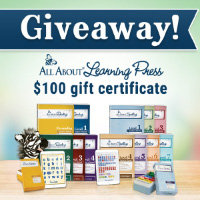
The materials included in All Reading Reading are:
- Teacher’s Manuals
- Student Activity Books
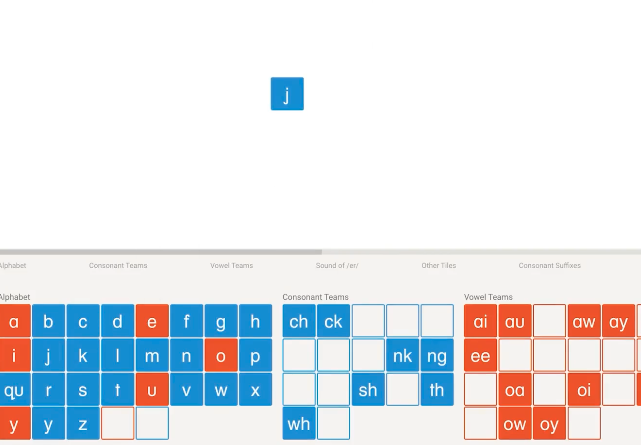
- Letter tiles
- Reading Review Cards
These are all physical materials (this is not a digital program), except for the letter tiles, where you have the option to use physical letter tiles, or their letter tiles app.

Cost and Guarantee
Let’s be honest: this program is not cheap.
- Pre-Reading Level: around $119
- Reading Levels: around $159.95 per level
- Additional materials (letter tiles, review boxes): one-time purchases
That said, All About Reading offers one of the best guarantees in the industry…
A full one-year, no-questions-asked money-back guarantee when purchased directly from their website (minus shipping)
That significantly lowers the risk of the investment.

How to Choose the Right Level
You can do a placement test on their site. You can do it here!
You may also access free samples of the program (including 2 lessons) for the different levels in All About Reading—see links below!
- Get free pre-reading samples (go all the way down to the section ‘Look Inside Pre-Reading Materials’)
- Get free Level 1 samples (go all the way down to the section ‘Look Inside Level 1 Materials’)
- Get free Level 2 samples (go all the way down to the section ‘Look Inside Level 2 Materials’)
- Get free Level 3 samples (go all the way down to the section ‘Look Inside Level 3 Materials’)
- Get free Level 4 samples (go all the way down to the section ‘Look Inside level 4 Materials’)
Verdict:
All About Reading is a strong choice if you want:
- A highly structured, research-based curriculum
- Multi-sensory instruction
- Explicit teaching with no guessing
- A program that works well for struggling readers and dyslexic learners
- A well-established homeschooling favorite
It may require more preparation and a higher financial investment than some other programs — but for many families, the clarity and thoroughness are absolutely worth it.
Its approach makes it favorite as well among families with struggling readers, and dyslexic students.
WANT TO KNOW MORE?
Check out our full review of All About Reading here!
Reading Program #3: Logic of English
IN A NUTSHELL
Who is it for: For children that learn through multi-sensory experiences, and logical thinkers.
Approach: Orton-Gillingham Approach to teaching reading.
Number of levels: Foundations: 4 levels (A, B, C, D). Essentials: 3 levels (Levels A, B, C)
Great if you are looking for… A multi-sensory program that delves deeply into the rules and logic of English, and integrates spelling, writing, and reading. A widely popular homeschooling curriculum, highly suited for struggling readers and dyslexics.
Guarantee: Offers 90-day money back guarantee when bought from their website. Products must be returned in good condition (like new).
Price:
Foundations: From $94.96 per set.
Individual materials: from $14.99.
Check final prices here.
Essentials: Whole sets from $126.83.
Individual materials: from $8.99.
Check final prices here.
How to Buy: From their website.
Also available on Amazon.
Logic of English is another Orton-Gillingham reading curriculum, making it an excellent choice for dyslexic or struggling readers.
Since we went through the Orton Gillingham approach before, I am not going to extend on this.
What Makes Logic of English Different?
Logic of English shares many strengths with All About Reading, but it takes a different philosophical approach in some key areas.
The biggest difference is right there in the name.
This program is built around the idea that English is not random — and that children benefit from understanding the logic behind spelling and sound patterns.
For some learners, this is incredibly empowering.
Other Differences Logic of English vs All About Reading
- Deeper Dive into English Rules: This program really takes the “no-gaps” approach to the next level! If your child needs to know the “why” of everything, consider this program! As its own name indicates, it goes deep into the “logic of English,” and the reasons behind the English spelling system and reading rules.
- Simultaneous Sound Introduction: Unlike most programs, this program introduces all the sounds a letter can make from the start. For instance, instead of teaching that letter “a” makes the short /a/ sound as in “apple,” it also covers the long “a” and the schwa sounds. I know… I can hear you thinking: “Isn’t this too overwhelming?” Well, that’s not how I personally approach reading instruction, but I understand how it can work—especially for logical thinkers and children that like to have clear rules. This way, they won’t get all confused when you, later on, have to reveal that the letter “a” has alternative sounds.
- More Games and Activities: If you thought that teaching English rules had to be boring, that’s not the case. You do teach the rules, but using lots of games and fun activities.
- Integrated Reading, Writing, and Spelling: Logic of English addresses all three areas simultaneously, potentially saving you money by not requiring separate purchases.
Manuscript vs. Cursive: A Notable Feature
If you decide to buy this program, you’ll need to decide between cursive or manuscript for writing.
This really stood out to me!
If you’re unsure of the difference, cursive looks like this (see picture below).

Not only cursive handwriting looks beautiful and takes out of the picture certain problems beginner readers struggle with, such as “b” and “d” reversal (as the letters “b” and “d” in cursive are not so interchangeable and confusing anymore)…
It turns out that learning through cursive typography can be extremely beneficial for the cognitive development of children!

While there is some controversy around this topic, some experts argue that cursive writing offers similar benefits to learning to play an instrument. If you want to find out more about this, you can check this article.
I will also include some links on the download my notes document, in case you are interested in digging into this more.
Foundations vs. Essentials: Which One Do You Need?
For a totally beginner reader, the Foundations module has four levels (A, B, C, D) and covers contents appropriate for Kindergarten to First Grade.

Their Essentials module has three levels (A, B, C), and is divided in five parts.
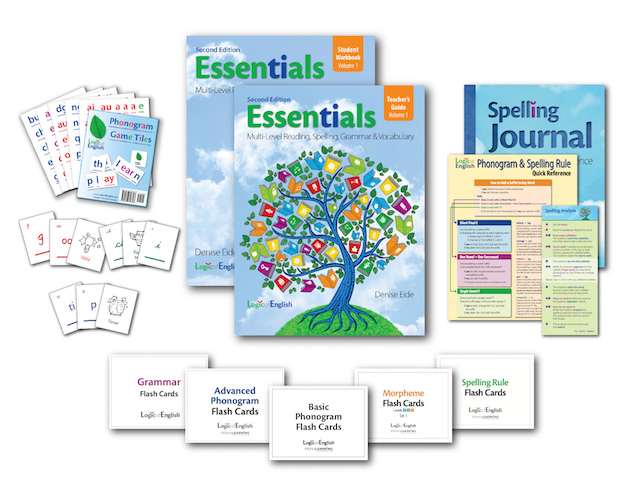
All of the materials on their Essentials module are included on their Essential package, but you can also buy materials individually.
You can take a quick test on their site to see which one they’d recommend for you.
How much does Logic of English cost?
Logic of English is a premium curriculum.
- Foundations sets typically start around $95–$100 per level
- Essentials sets are priced higher, depending on the package
It may look a bit more expensive than All About Reading on the surface. However, since it includes spelling and writing instruction within the program, the overall cost ends up being quite similar.
Plus, they offer a 90-day money-back guarantee.
Verdict
Logic of English is an excellent choice if you want:
- A deep, explicit explanation of how English works
- A strong Orton-Gillingham–based program
- Integrated reading, spelling, and writing
- A curriculum that supports dyslexic and struggling readers
- A logical, rule-based approach to phonics
It may not be the simplest or lightest program on this list, but for the right child, it can be incredibly effective.
If you have a kid that is constantly wants to know all the whys, seriously consider Logic of English!
Reading Program #4: Hooked on Phonics
IN A NUTSHELL
Who is it for: Ideal for children who thrive with a clear, structured routine and benefit from audio-visual aids, like video-lessons.
System: Sequential, systematic, synthetic phonics approach.
Number of levels: 8 reading levels. The program can be used alongside their app, which includes spelling lessons through “Hooked on Spelling.”
Perfect for… Parents looking for a simple, engaging approach that uses video lessons and an app. It’s especially convenient for busy parents, as most of the work is already done for you!
Complete Learn to Read Kit (all levels): $209
30-day money back guarantee when you buy from their website.
How to Buy: From their website OR on Amazon.
What is Hooked on Phonics?
Hooked on Phonics is one of the most well-known reading programs in the U.S., and it has been around for decades.
At its core, it is a structured phonics curriculum designed to take children from
- At its core, it is a structured phonics curriculum designed to take children from:
- Early phonemic awareness
- To letter–sound correspondence
- To blending and decoding
- And all the way to reading connected texts and multi-syllable words, reaching approximately an end-of-second-grade reading level by the final stages of the program.
The program builds skills in a predictable, linear way, which is reassuring for both children and parents.
It is also aligned with Common Core standards, which can be helpful for U.S. homeschooling families who want their instruction to stay in line with school expectations.
Hooked on Phonics: A Very Predictable Lesson Structure (This Is Key)
This phonics program features a very consistent, easy-to-implement lesson structure.
It requires minimal preparation, uses only a few materials, and parents don’t need to know much about phonics to teach the lessons successfully. The work is “done for you.”
Every lesson follows roughly the same structure:
- Watch a short video lesson:
This covers the learning part of the lesson. For this, you can use a DVD or access it online.
The video introduces the phonics concept in a child-friendly, engaging way. - Complete the workbook pages
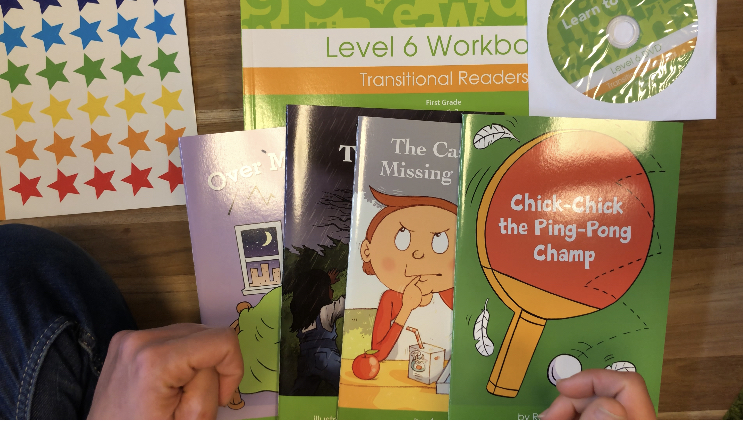
These reinforce what was presented in the video through guided practice. - Read decodable readers
Children apply what they’ve learned in books designed to match their current skill level. - Positive reinforcement
Stickers and small rewards help motivate children and build confidence.
Some lessons also include fun games, and review. Hooked on Phonics also includes readers at level with the lessons.
Important Practical Notes
The program is less flexible than OG-based curricula.
It relies more on presentation and practice than deep rule explanation.
And, an important heads up! If you want to access the videos online (who has a DVD player these days?), avoid buying second-hand kits, as you’ll have to register your kit, and the registration might already have been taken.
You may also want to look into the option of getting their app & materials bundle, which includes access to their app, and the corresponding Hooked on Phonics materials delivered to your doorstep.
This bundle also includes access to their Hooked on Spelling, and Hooked on Math materials, at no extra cost.
More info in the next section!
The Super Convenient Way to Hooked on Phonics: App with Delivered Materials Bundle
One thing that many parents find useful — especially if you like the simplicity and structure of Hooked on Phonics — is to consider a bundle that combines the app with physical materials shipped to your home.
With their subscription bundle, you get:
- Unlimited access to the Hooked on Phonics app (including phonics lessons, interactive activities, and progress tracking across multiple learner profiles),
- Curriculum materials (workbooks, storybooks, and practice packs) delivered to your door to match the skills your child is working on each month.
This can be a very convenient setup because you get the additional engaging interactive practice of the app, and the convenience of materials delivered right to your door.

Their Hooked on Phonics App & Practice Pack Subscription Bundle is only $1/first month (CA$2.99, for Canada users).
This gives you plenty of time to decide without any risk–no lock-in contracts– whether this option works well for you or not.
After that, the cost is $12.99/ month.
This option is only available for US and Canada users.
Check the offer below!
Any Downsides to Hooked on Phonics? Hooked on Phonics Cons
Here are the main limitations:
- Less explicit phonemic awareness than top Orton-Gillingham or Direct Instruction programs: Hooked on Phonics introduces phonemic awareness skills early on, but it does so in a lighter, less systematic way than programs like Children Learning Reading, All About Reading, or Logic of English. For many children, this is perfectly sufficient However, children who struggle to hear and manipulate individual sounds, have difficulty blending sounds into word, or are at risk for reading difficulties may benefit from a program with a stronger, more explicit phonemic awareness component.
- Heavy reliance on videos: A core feature of Hooked on Phonics is its use of short instructional videos. This is a strength for children who enjoy screen-based instruction, and stay engaged with video lessons. However, it can be a con if you want to avoid screens altogether in your reading instruction.
- Might not be the best fit for struggling or dyslexic students: For children with dyslexia or persistent reading difficulties, a more diagnostic and responsive program may be a better long-term fit.
- Can feel repetitive for children who crave more variety: Having said that, many children love (a benefit from!) having a consistent and predictable routine.
None of these limitations mean Hooked on Phonics is a “bad” program. They simply mean that, as all programs, it probably won’t be the best fit for every child.
Who is Hooked on Phonics for?
Hooked on Phonics is a solid choice if you want:
- A predictable, structured routine
- Minimal prep and clear guidance
- Audio-visual instruction
- A program that feels approachable and familiar
- Something that fits easily into a busy family schedule
It may not be the most intensive or customizable phonics program on this list — but for the right child and family, its simplicity is exactly what makes it effective.
Verdict:
If your child is progressing typically and you want a simple, structured, low-stress approach to teaching reading, Hooked on Phonics can be a very good choice.
It may be costly for some families, but if you’re confident this system will help your child succeed, the Complete Learn to Read kit, which includes all 8 levels, offers significant savings.
Also, in you are based in the US or Canada, you may want to explore their risk-free Subscription Bundle.
WANT TO KNOW MORE?
Check out our full review of Hooked on Phonics here!
Reading Program #5: Reading.com
Who is it for: Beginning readers. Takes children from basic letter recognition skills to approx. 2nd grade reading level.
Approach: Based on solid synthetic phonics principles and the Direct Instruction method to teaching reading.
Number of levels: One (all in one single app!)
Great if you are looking for… A digital curriculum with super convenient implementation.
Price: 7-day free trial. After that, only $6.25 a month (yearly subscription) or $12.49/month (monthly subscription).
If you’re open to using a digital-only curriculum, like an app, Reading.com is worth considering!
What is Reading.com?
Reading.com is a full literacy curriculum in an app!
It takes children from basic letter recognition to fluent reading, to approximately a 2nd-grade reading level.
It offers 99 fully scripted lessons based on the Direct Instruction (DI) model, which provides clear, step-by-step guidance with precise instructions.
This makes it easy for parents or teachers to lead lessons without needing specialized training.
It also means that there’s no preparation required, and that you are done with the lesson in ten to twenty minutes.
The app also includes a library of scaffolded and decodable digital books, ensuring that children read at a level suited to their phonics skills.
It also includes fun and engaging printable worksheets and educational games to reinforce learning.
Can children really learn to read independently using an app?
Reading.com is a structured reading curriculum delivered through an app, but it’s important to understand what that actually means.
This is not an app where children are expected to learn to read independently while adults step away.
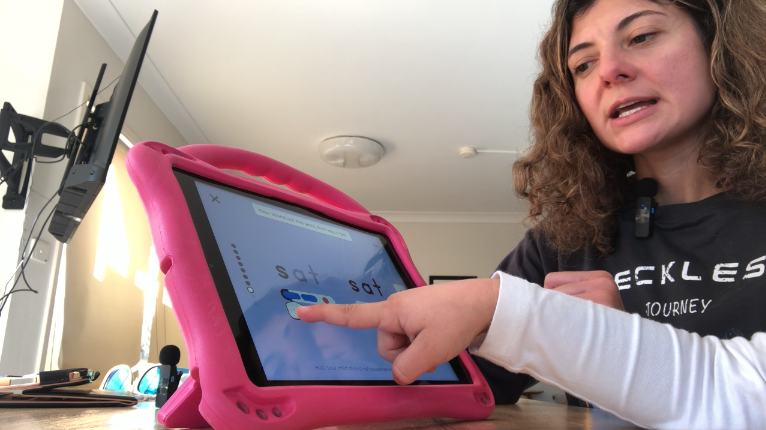
Instead, Reading.com is designed as a co-learning experience.
In fact, this format makes the app extra special, in my opinion. Adult and child work together with the support of an engaging high-quality app—this not only improves learning but also strengthens your bond.
The Role of Reading Instruction
The Direct Instruction (DI) approach is known for being:
- Highly explicit
- Carefully sequenced
- Scripted to reduce ambiguity, or misinterpretations
In Reading.com, this means that lessons are predictable and efficient.
Each lesson typically takes 10–20 minutes, and there is no preparation required. Besides, you are told exactly what to say, and guided step by step.
This makes it especially appealing for busy parents, educators working with multiple students, and families who want clarity and efficiency.
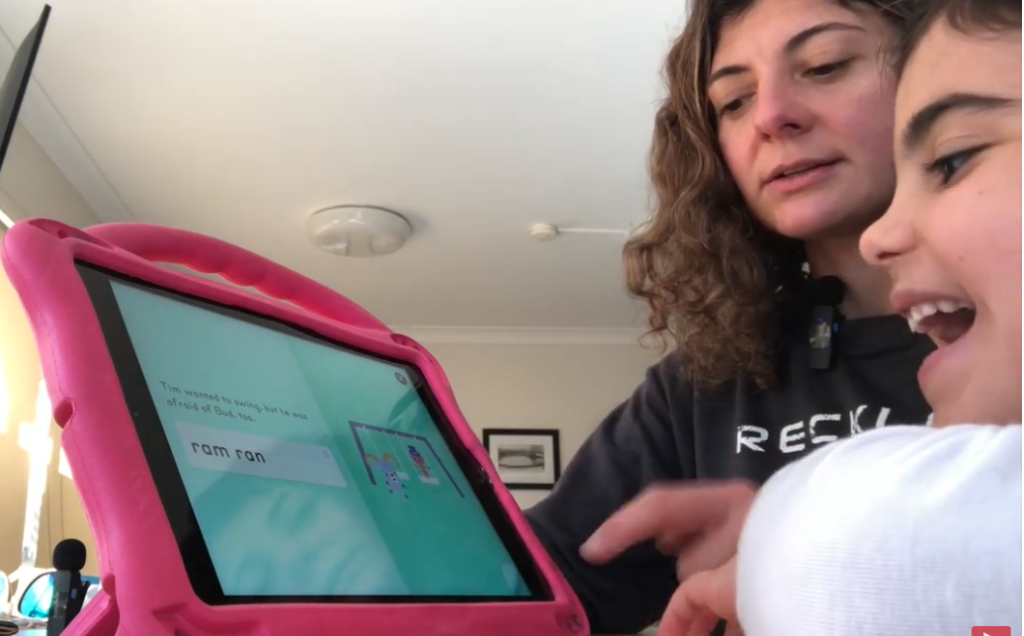
Built-In Decodable Reading Practice
Reading.com includes a library of scaffolded, decodable digital books that align with the phonics skills being taught.
This is a big plus.
Children are not asked to read texts that contain patterns they haven’t learned yet, which reduces guessing and builds confidence.
The app also includes printable worksheets, and educational games for reinforcement.
These extras are optional, but they can be useful for extra practice, and for extending learning beyond the screen.
Letter Tracing and Writing: What to Expect
Reading.com includes letter tracing using a finger on the screen, which can help reinforce letter formation and directionality.
However, it does not teach handwriting, and doesn’t provide a full writing curriculum (even if some of the printables include writing practice).
In any case, for writing and spelling, you’ll need to supplement instruction with an alternative program.
Sliders in Reading.com – my favorite feature!
The digital sliders are, hands down, my favorite feature in the app.
Why? They truly helped my youngest daughter “get” blending —one of the trickiest parts of early reading.
They are super intuitive, and engage both the auditory and tactile senses.
This is how it works:
Kids move their finger along the letters as they sound the words out. They do it slowly first; then, fast.
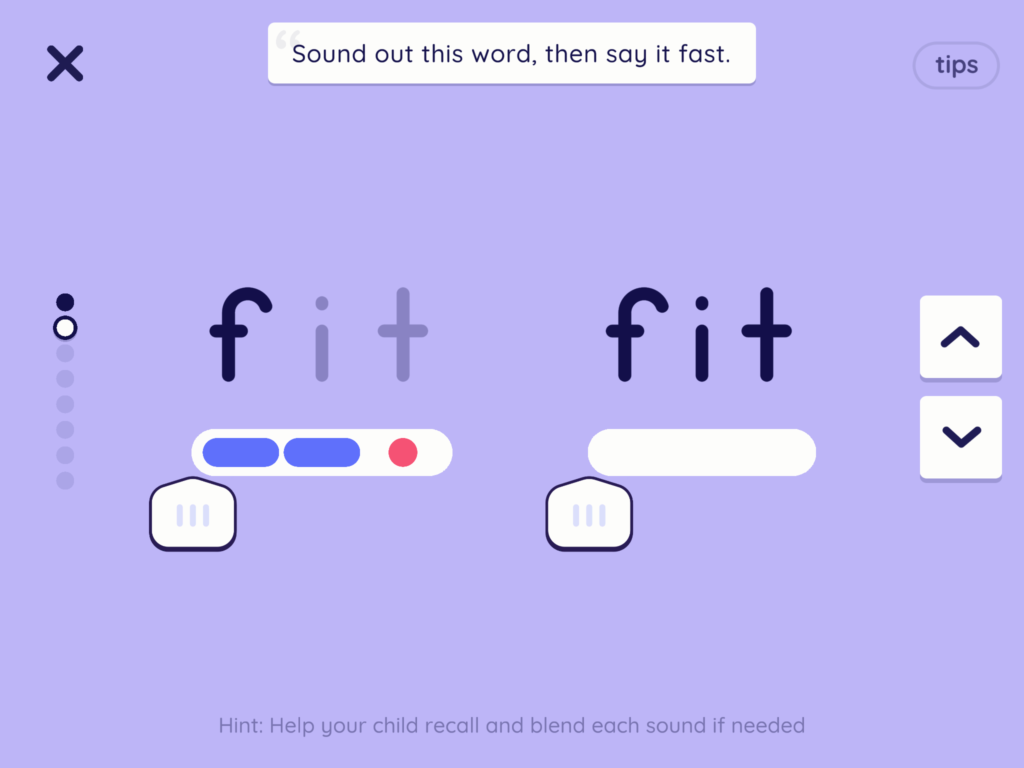
For my kid, this was the feature that finally made blending click.
If your child knows letter sound, but struggles to put them together into words
…the sliders alone may be worth trying the app.
Limitations to Be Aware Of: Reading.com Cons
To give you the full picture, here are the main limitations of Reading.com:
- It is digital-only (no physical readers unless you print materials)
- Writing and spelling instruction are limited
- It requires active adult involvement
- Not ideal if you are avoiding screens altogether
For children with significant phonological difficulties or dyslexia, a more intensive OG-based program may still be a better fit. However, Reading.com should not be entirely ruled out, as Direct Instruction has proven to be highly effective in large-scale studies for struggling readers and students at risk for reading failure, particularly when instruction is explicit, systematic, and carefully sequenced.
Verdict:
Reading.com is a strong, well-designed digital reading curriculum that works best when used as intended: with an adult guiding each lesson.
It excellent if you are looking for:
- Clear, scripted instruction
- No prep and fast lessons
- A fully digital setup
- Strong support for blending
- Affordable monthly pricing
If you’re comfortable with screen-based learning and willing to sit alongside your child, Reading.com can be a very effective and convenient way to teach reading, especially for beginning readers who need extra help with blending. Remember: the sliders!
WANT TO LEARN MORE ABOUT THIS CURRICULUM?
Check out our full review of Reading.com here!
Reading Program #6: Funnix
IN A NUTSHELL
Who is it for: Children who need very explicit instruction, lots of repetition, and ongoing review to make sure skills truly stick before new material is introduced.
Approach: Direct Instruction (DI) model to Teaching Reading.
Number of levels: 2 (Funnix Beginning Reading, and Funnix 2).
Great if you are looking for… A no-nonsense, teacher-style program with step-by-step instruction.
You care more about progress and mastery than entertainment, and you’re fine with a highly structured, repetitive format.
What it covers: Reading only — from beginner decoding to approximately an end-of-second-grade reading level. Spelling and writing are not taught as standalone skills.
Price: From $24.99/month for a family subscription. Approx. 20% off on annual plan.
Special offer: Learning Reading Hub readers can get Funnix for $14.99/month (discount automatically applied here!)
How to get it: Sign up directly at the Funnix website for family or tutor plans. Benefit from our exclusive offer here (discount automatically applied).
What is Funnix?
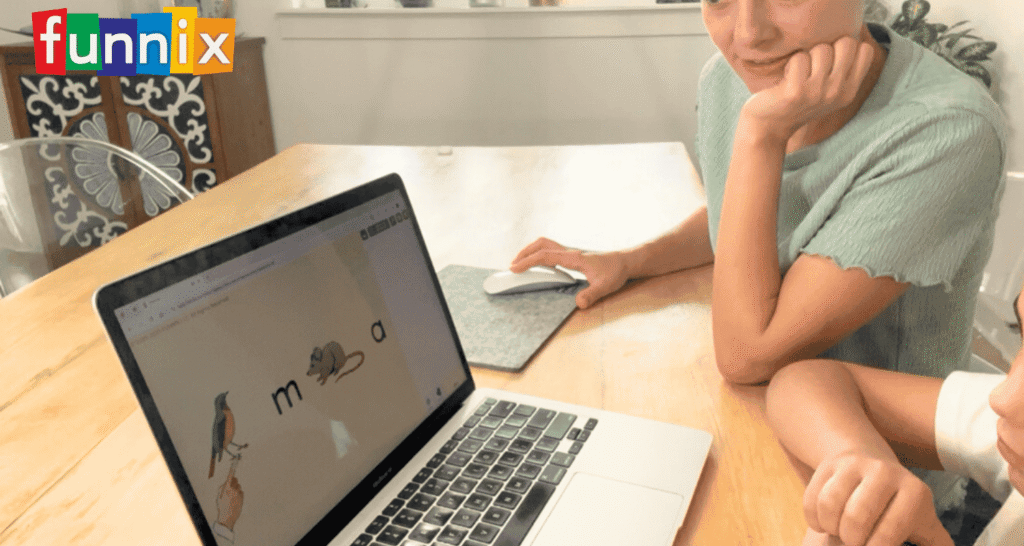
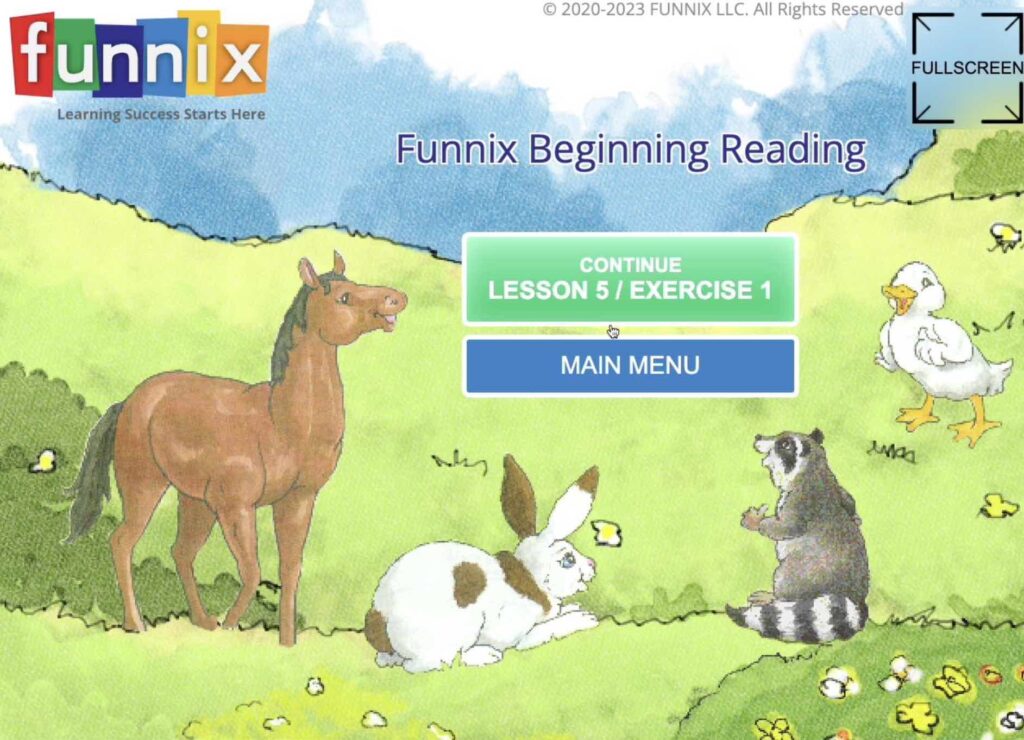
Funnix is a web-based literacy app to teach your child to read. Kids are ready to start once they know just a few letters. To be more precise, they should at least know four out of these five letters: e, f, m, o, r.
I personally see it more like a software, since you won’t find it on the App Store or Google Play, and it is designed to be used on a computer.
If you’re familiar with Teach Your Child to Read in 100 Easy Lessons, the philosophy behind Funnix will feel very familiar!
Funnix was created by Siegfried Engelmann, the same educator behind Teach Your Child to Read in 100 Easy Lessons and the pioneer of the Direct Instruction approach.
Funnix is essentially the digital evolution of that original program. It keeps the same core principles (explicit teaching, carefully sequenced lessons, constant review, and mastery before moving on), but delivers them through a web-based platform that guides both the child and the parent step by step.
In other words, Funnix takes a method that has stood the test of time and translates it into a structured, computer-guided reading program, while staying true to the instructional philosophy that made the original book so effective.
The Roots of Funnix
The roots of Funnix go all the way back to the 1960s, when Siegfried Engelmann, then at the University of Illinois, developed Direct Instruction as an explicit, carefully sequenced approach to teaching foundational skills like reading.
Over the following decades, Engelmann authored more than 100 instructional programs, all rigorously field-tested and repeatedly revised to ensure they worked with real students — including struggling readers.
This body of work includes well-known programs such as “Teach Your Child to Read in 100 Easy Lessons” or “Reading Mastery,” which have been used successfully in classrooms and homes around the world for over 50 years.
In 1998, Siegfried and his son Owen Engelmann adapted these proven Direct Instruction reading programs into a computer-based format for homeschool families… and that’s how Funnix was born!
Initially released as a series of DVDs, Funnix later evolved with the technology and, in 2022, made the transition to a fully web-based online program.
How Funnix Lessons Are Designed
Funnix lessons are intentionally predictable and systematic.
Each lesson follows the same instructional logic:
- Only a small amount of new material is introduced (about 10%)
- Most of the lesson (around 90%) is spent reviewing and practicing previously learned skills
- Skills are revisited again and again so they don’t fade or get forgotten
- Lessons move in a clear sequence:
sounds → words → connected reading
The Constant Review in Funnix
This constant review is one of the program’s landmark features. It ensures children truly master what they learn before moving on, rather than just being exposed to it once and hoping it sticks.
This can be especially helpful for children who seem to “know it today and forget it tomorrow.” For many kids, information initially lives in short-term memory, and without enough repetition and review, it never makes the jump into long-term memory. Unfortunately, many curricula move on too quickly and don’t account for this very common learning hurdle.
If your child, for example, has had a hard time holding onto letter sounds, numbers, or basic facts, chances are they’ll benefit from a program with heavy, built-in review.
I’ve seen this firsthand at home. One of my kids has always needed extra repetition for core concepts — counting, letters, basic math facts — not because she wasn’t capable, but because those ideas didn’t automatically “stick” in long-term memory.
For children like this, programs that slow down, revisit skills often, and prioritize mastery can make a huge difference in confidence and progress.
Printable Practice (Yes, There’s Pencil-and-Paper Work)
Even though Funnix is a web-based app, it also includes printable worksheets for each lesson.
These worksheets:
- Reinforce the exact skills taught on screen
- Provide important pen-and-paper practice
- Help children transfer decoding skills beyond the digital environment
This makes Funnix feel less like a “screen-only app” and more like a structured reading lesson delivered digitally.
However, this is not a complete learn-to-write curriculum in itself, and you’ll need to reinforce writing skills using additional materials, in my opinion.
What Is the Parent’s Role?
Funnix is not designed for independent use.
Instead, lessons are built around a parent-guided model.
As a parent (or tutor), you’ll sit next to your child, and follow along with the prompts on screen. You’ll also encourage responses and effort, and be in control of pacing (you decide when to pause, repeat, or move on)
The software delivers the instruction, models responses, and structures practice, while you provide the human support.
Many parents describe Funnix as feeling like a built-in literacy coach. Why? Because you don’t have to plan lessons or decide what comes next, but you’re still actively involved in the learning process.
Funnix: Cons to Be Aware Of
Funnix is a strong program, but it’s not for everyone. You should take this into consideration when deciding if Funnix is the right fit for your kid or not.
- Very structured and repetitive by design.
The constant review is a strength for many children, but kids who crave novelty or variety may find the lessons repetitive over time. - Not a “fun” or gamified app.
Funnix prioritizes instruction and mastery over entertainment. If your child expects games, animations, or rewards, this may feel dry. - Requires active adult involvement.
This is not an independent program. A parent or tutor needs to sit alongside the child for each lesson. - Computer-based only.
Funnix is a web-based program designed for use on a computer, not tablets or phones, which may be a limitation for some families. - Less flexible than OG-style programs.
The sequence is fixed and scripted. While this is intentional, it allows less room for adapting lessons on the fly.
Who Is Funnix Best For?
Funnix tends to work especially well for:
- Children who need very explicit instruction, lots of repetition, and constant review
- Learners who benefit from a predictable, teacher-like routine
- Families who value results and mastery over entertainment
- Parents who want clear guidance and don’t want to guess what to teach next
Verdict:
Funnix is a highly effective, research-based reading program for children who need explicit instruction, repetition, and constant review to make learning stick.
For families who value mastery over entertainment and want a teacher-like program at home, Funnix can be an excellent choice — especially for struggling readers.
Funnix may be less ideal if your child needs a more flexible, multi-sensory approach, learns best through play-based or discovery learning, or is highly motivated by games and visuals.
WANT TO LEARN MORE?
Then you may read this full Funnix review here!
Reading Program #7: Reading Horizons at Home
IN A NUTSHELL
Who is it for? Struggling readers, dyslexic students, logical/analytical thinkers, older and intervention students.
Approach: Orton-Gillingham + analytical principles (unique marking system).
Number of Levels: 2— Discovery (K-3) and Elevate (4-12 and adults).
Great If You Want: Intervention-level instruction. A method specifically designed for logical, analytical learners.
What It Covers: Reading + spelling. Discovery for K-3 students, and Elevate for older students (grades 4-12 and adults).
Price: From $199 per year.
Try 30 days for $10 here.
What is Reading Horizons?
Reading Horizons is a structured literacy curriculum based on the Orton-Gillingham (OG) approach, and it has been specifically designed for students who struggle with reading.
It is especially well suited for:
- Struggling readers
- Students with dyslexia
- Learners with language-based learning difficulties
- English language learners (ELL / ESL)
That said, Reading Horizons can absolutely be used with any child learning to read. However, there are several aspects of its design that make it particularly effective for learners who have not responded well to more traditional or less explicit methods.
Especially, for logical/analytical thinkers… Why? Their unique marking system.
Reading Horizons’ Unique Marking System
What makes Reading Horizons stand out from other OG-based programs is its unique marking system.
This marking system teaches students to analyze and “mark up” words, in order to “prove” how they are read.
I know — it sounds weird, unusual and complicated at first. But I promise it’s way easier than it sounds once you see the system in action.
Watch the video below to see an example of how Reading Horizons goes about “marking“ and “proving” words.
The video is set to start at minute 8:15, where you can see a clear demonstration of the process.
This approach is especially powerful for logical and analytical thinkers.
Many children with dyslexia are strong logical and analytical thinkers who respond well to clear rules, step-by-step procedures, and consistent routines.
Reading Horizons was designed with this type of learner in mind!
Instead of relying on intuition or memorization, students are shown exactly how a word works, which removes much of the guesswork and frustration from reading.
Other Unique Features in Reading Horizons
Apart from the Marking System, Here Are Other Key Features Parents Should Know
- Multi-sensory, OG-aligned instruction
In line with the Orton-Gillingham approach, Reading Horizons engages multiple learning pathways — visual, auditory, and kinesthetic/logical — to help students process and retain phonics concepts more effectively. This multi-sensory integration is especially beneficial for struggling and dyslexic readers.
- Broad age range and flexible use
Unlike many phonics programs designed only for beginners, Reading Horizons supports learners from early elementary through adolescence and adulthood, making it suitable both as a core reading curriculum and as an intervention program.
- Strong research alignment
The Reading Horizons Discovery curriculum received an “all green” rating from EdReports for its alignment with research-based best practices in foundational literacy instruction.
Reading Horizons Format: Digital, Print, or Both?
Reading Horizons is not strictly a digital curriculum. It’s best described as a hybrid program.
Depending on the option you choose, Reading Horizons can include:
- Online lessons/software (for instruction, practice, and progress tracking)
- Printed materials (workbooks, lesson resources, and practice pages)
Most families benefit from the blended approach: the online instruction provides structure and pacing, while the printed materials reinforce skills offline, which can be especially helpful for struggling readers who benefit from slower, hands-on practice.
Having said this, it all depends on your particular case. Some families simply use the software as a reinforcement or intervention tool.
Reading Horizons Cons
No program is perfect for every family and child. Consider these points before choosing this program:
- Lessons less playful and more academic compared with gamified apps.
- The system can be challenging to administer without some familiarity with the interface, especially during initial setup.
- Children who do best with very light, playful instruction or highly condensed fun formats may find it more structured than necessary.
- While the marking and pattern systems are powerful, they may feel overwhelming at first for very young non-readers.
Verdict
Reading Horizons is a strong intervention-focused literacy program built on Orton-Gillingham principles, designed especially for struggling readers, dyslexic learners, and logical thinkers.
Its distinctive marking system may feel a bit quirky at first, but that’s exactly what makes it so effective for students who need reading to feel logical, predictable, and rule-based.
If your child has tried other programs without success and needs a clear, structured way to decode words, Reading Horizons can be a very effective tool to close reading gaps.
WANT TO LEARN MORE?
Check out my full review of Reading Horizons here!
#8: Phonics Pathways
IN A NUTSHELL
Who is it for: Struggling readers, children that find blending particularly difficult, or students with learning disabilities, such us dyslexia. Also a strong fit for older students that thrive on very structured lessons.
Approach: Systematic synthetic phonics combined with successive blending, the hallmark of this curriculum.
Number of levels: All-in-one manual. One book covers instruction from Kindergarten through about 4th grade.
Great if you are after: A simple, effective, low-cost program, especially if blending has been a major roadblock, and want to try successive blending.
Price: $20 (approximately – check final price on Amazon)
30-day money back guarantee when you buy from Amazon.
How to Buy: Get it on Amazon here!
What is Phonics Pathways?
Phonics Pathways is a comprehensive reading curriculum that also uses the synthetic phonics approach to teaching reading.
However, there’s something that really makes it stand out from the rest…
How the concept of successive blending has been fully integrated in this reading program. To be honest, successive blending is this curriculum’s flagship really.
So, what is successive blending, exactly? And how can it help a child learn to read?
Main Feature in Phonics Pathways: Successive Blending
Successive blending is a blending strategy that, in fairness, all children may not need, because for some it could mean going more slowly than they actually need.
However, for those that struggle with blending, it can be a real life-changer!

- Used Book in Good Condition
- Hiskes, Dolores G. (Author)
- English (Publication Language)
- 288 Pages – 05/17/2011 (Publication Date) – Jossey-Bass (Publisher)
With successive blending, you are trained to read words very gradually, breaking down the process into simple steps. You blend a maximum of two letters at the time, even when attempting to read longer words.
For instance, these would be the step-by-step process to read the word “mat” with successive blending:
- Step 1: m-a
- Step 2: ma
- Step 3: ma-t
- Step 4: mat
If you still don’t understand the system, you may want to take a look at these videos.
Video #1:
Comprehensive explanation of Successive Blending (skip to Strategy #5 in the video)
Video #2:
Quick demonstration of Successive Blending in practice!
Phonics Pathways is especially helpful when blending feels effortful and extremely frustrating; or when progress has stalled despite phonics instruction.
Does Your Child Know the Sounds But Can’t Blend?
Successive blending is a technique designed to help children who struggle to hold letter sounds in memory long enough to blend them together.
By the time they get to the last letter sound in a word, they have forgotten all about the first one… making blending feel nearly impossible.
It often looks something like this:
m–a–t.
“Great job! Now put it all together!”
“Spaghetti!”
“…What?”
“Okay, try again.”
“Broccoli!”
This difficulty is very common in younger learners and often resolves naturally as working memory develops. However, when the problem persists, it can seriously slow down reading progress.
That’s where successive blending can be a life-saver. By teaching children to blend sounds gradually and in small steps, it reduces memory overload and gives struggling readers a clear path to success.
Extremely well-suited for children that can’t hold all the letter sounds in their memory for very long.
By the time, they get to the last letter sound… they have forgotten all about the first one, and–therefore–are incapable of reading words.
Other Notable Features in Phonics Pathways:
- Extremely systematic and sequential: Children build upon what they already know slowly and incrementally.
- Includes extensive practice: I really appreciate the amount of practice this curriculum includes. Besides, some of these practice are particularly good. For instance, dictation-based activities, real/nonsense word-practice and pyramid exercises, etc.
- Very long and thorough: Suitable for extended use (from K to 4th grade)
- Includes a spelling appendix after the main reading instruction: There’s an appendix for spelling for when you’re done with your focus on learn to read, basically. So, we could consider Phonics Pathway a Reading + Spelling curriculum.
- Used Book in Good Condition
- Hiskes, Dolores G. (Author)
- English (Publication Language)
- 288 Pages – 05/17/2011 (Publication Date) – Jossey-Bass (Publisher)
Phonics Pathways: Cons
- Can feel slow or repetitive for children who don’t need successive blending
- Requires plenty of adult guidance and consistency
- Not ideal as a first-choice program for children who blend easily
Who Is Phonics Pathways Best For?
Phonics Pathways works best for:
- Families looking for a budget-friendly intervention tool
- Children who struggle significantly with blending
- Students with dyslexia or decoding difficulties
- Older students who need to rebuild reading from the ground up
Verdict
Phonics Pathways’ strength lies in its successive blending approach, which can be incredibly effective for children who know their letter sounds but repeatedly get stuck when blending words. If blending has been the main barrier to progress, and the underlying issue is difficulty retaining sounds long enough to blend them together, this curriculum could make decoding finally possible.
- Used Book in Good Condition
- Hiskes, Dolores G. (Author)
- English (Publication Language)
- 288 Pages – 05/17/2011 (Publication Date) – Jossey-Bass (Publisher)
Reading Program #9: Teach Your Child to Read in 100 Easy Lessons
IN A NUTSHELL
Who is it for? Parents who want maximum structure and guidance, especially for struggling readers or older beginners.
Approach: Direct Instruction (DISTAR) — highly scripted, explicit, and rigid by design.
Number of levels: One single manual. All instruction is included in one book.
Great if you want: A proven, no-guesswork program where you are told exactly what to say and do.
What it covers: Reading instruction only, with some writing tasks used to reinforce reading. Takes children to approximately a solid second-grade reading level.
Price Usually under $20 on Amazon.

“Teach Your Child to Read In 100 Easy Lessons has been endorsed by the National Right to Read Foundation as an exemplary instructional program for teaching children to read…The program is academically sound–the results speak for themselves. The continued problem of illiteracy is an enormous one, but [this book has] made a very significant contribution to solving one of American’s greatest needs.”
Robert W. Sweet, Co-founder and Former President, National Right to Read Foundation
What is Teach Your Child to Read in 100 Easy Lessons?
Teach Your Child to Read in 100 Easy Lessons is a comprehensive manual (all in a single level) designed primarily for parents that want to teach their children to read in a one-to-one setting at home.
This program offers a very structured approach to teaching reading through scripted lessons. This program is heavily-scripted, as opposed to lightly scripted, as other programs’ we’ve learned about before.
There’s no room for flexibility with Teach Your Child to Read in 100 Easy Lessons. Every single detail (the way to give instructions, the way you model, the way you correct your child) has been pre-defined for you… and needs to be done in a very particular way!
The program is designed to take the child to a solid second-grade reading level upon completion.
What’s the system in Teach Your Child to Read in 100 Easy Lessons?
“Teach Your Child to Read in 100 Easy Lessons” uses the DISTAR method (Direct Instruction).
This system was developed back in the 1960s by one of this manual’s co-author, Sigfried Engelman, as we’ve learned before.
Apart from one-on-one scripted lessons, the manual introduces a unique alphabet with symbols and graphic cues.
For instance, long vowel sounds are marked with a line on top, the “ng” digraph with an ark, etc. Se picture below.

These are called diacritical marks, and are there to aid children when reading. They signal how letters should be read, especially when there are different alternatives for the same letter or group of letters, or when letters team up to make a new sound, like the letter combination “th,” or “oo.”
The manual includes a section guiding parents to learn about the sounds themselves, since precise pronunciation is crucial in the DISTAR system.
The lessons are recommended to be conducted in 12 to 20 minutes per day, with an emphasis on creating a routine for consistency.
Effectiveness of the DISTAR Method
This method has demonstrated effectiveness through large-scale studies… and has really passed the test of time!
Many homeschooling families report really positive results using Teach Your Child to Read in 100 Easy Lessons.
However, it isn’t everyone’s cup of tea!
Why? Well, some people find this system too rigid, stilted and repetitive.
Teach Your Child to Read in 100 Easy Lessons: Cons
- Very rigid and inflexible
- Diacritical marks can feel unusual and may require transition later
- Not engaging or playful
- Not ideal for parents who prefer autonomy or creativity
Who is Teach Your Child to Read in 100 Easy Lessons for?
This program works best for:
- Parents who want clear, step-by-step instructions
- Children who need strong structure and repetition
- Families who value effectiveness over aesthetics
- Struggling readers who need explicit guidance
Verdict:
Teach Your Child to Read in 100 Easy Lessons is a highly effective, research-backed classic. Its rigidity and unusual symbols aren’t for everyone, but when followed as intended, it can deliver remarkable results. If you want a clear script and proven method, this book still holds up decades later.
- ABIS_BOOK
- Engelmann, Siegfried (Author)
- English (Publication Language)
- 420 Pages – 06/15/1986 (Publication Date) – Avid Reader Press / Simon & Schuster (Publisher)
Reading Program #10: Alpha Phonics
Who is it for? Parents looking for a minimalist, traditional phonics approach that focuses on decoding skills without games, visuals, or built-in structure.
System: A phonics primer focused on drilling, repetition, and sequential skill-building.
Number of levels: One all-in-one book.
Great if you want: A no-frills, cost-effective program that focuses purely on decoding skills.
What it covers: Reading instruction only.
Price: Around $20 on Amazon. Check final price on Amazon here!
What Is Alpha Phonics?
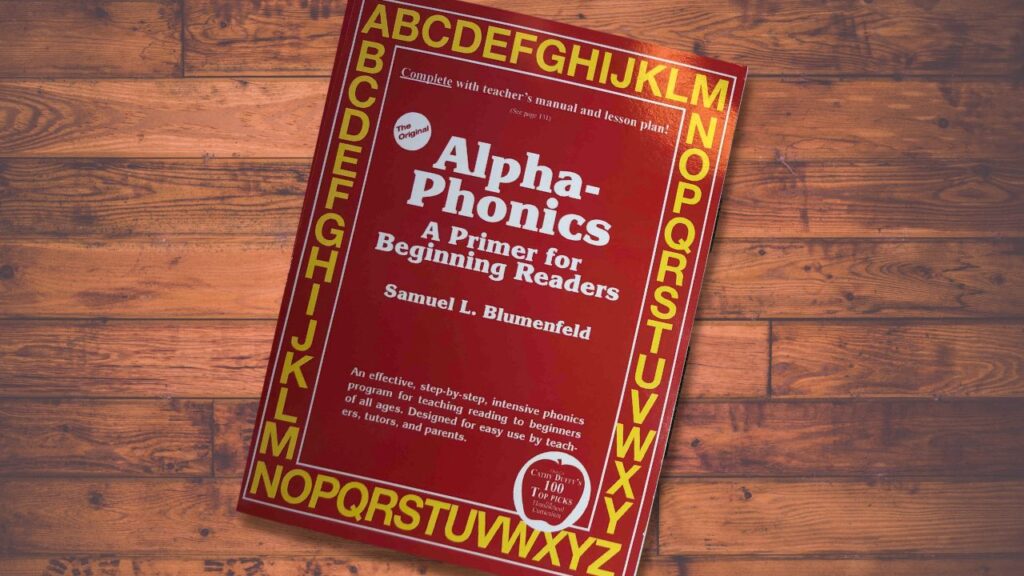
Alpha Phonics is a traditional phonics primer, developed by educator and homeschooling advocate Samuel L. Blumenfeld.
Phonics primers are one of the oldest approaches to teaching reading and rely heavily on:
- Repetition
- Drill
- Logical sequencing
- Sound awareness
Alpha Phonics intentionally avoids pictures to prevent guessing.
This program takes a straightforward, no-nonsense approach to phonics-based reading instruction.

- Blumenfeld, Samuel L (Author)
- English (Publication Language)
- 182 Pages – 11/01/2023 (Publication Date) – Paradigm Company (Publisher)
What is a Phonics Primer?
Phonics primers represent one of the oldest methods for teaching reading.
As explained earlier, the system is simple… but effective: drilling and repetition.
Phonics primers also stress sound awareness and use a sensible sequence for the introduction of letters, sounds, etc., making sure we gradually go from simple to more complex concepts.
A quick glance at the approach in Alpha Phonics
- Start by teaching the alphabet, focusing on letter names only.
- Lessons are short (5-15 lines of text) but cover a lot of ground quickly.
- The program is sequential and logical, building on previous knowledge.
- It avoids pictures to prevent reliance on visual cues.
Pros of Alpha Phonics
- Introduces sight words in context with similar spelling patterns, aiding memorization.
- Effective at teaching reading without guessing.
- Cost-effective and minimalistic.
- Certain room for flexibility in lesson implementation.
Cons of Alpha Phonics
- Moves quickly, may require reviewing lessons.
- Lacks visual aids, requiring additional memorization strategies.
- Not a writing program, though it provides some guidance.
Who is Alpha Phonics for?
Alpha Phonics works best for:
- Families who value simplicity and flexibility
- Children who respond well to repetition and structure
- Parents comfortable guiding instruction themselves
- Situations where budget is a key concern: However, bear in mind that you may need to complement with additional materials, like decodable readers. In that regard, Alpha Phonics has its own you can also get on Amazon, for extra convenience.
Verdict
Alpha Phonics is a straightforward, traditional phonics primer that prioritizes logic, repetition, and sequence. While it lacks visual supports and modern features, it can build strong decoding skills when paired with enough practice and reading materials.
- Blumenfeld, Samuel L (Author)
- English (Publication Language)
- 182 Pages – 11/01/2023 (Publication Date) – Paradigm Company (Publisher)

- Samuel L. Blumenfeld (Author)
- English (Publication Language)
- 329 Pages – 01/01/2011 (Publication Date) – Storehouse Press (Publisher)
Still unsure on the which program to pick?
THIS MAY HELP!
Take the quiz – Discover the right curriculum for you in 5 minutes!

Hey there! I’m Laura – an author, YouTuber, blogger, and the creator of the “Learning Reading Hub” platform. I created this space to dive into the world of reading instruction and to shout from the rooftops about how vital it is to use the right methods for teaching reading. I’ve got a TEYL certification (Teaching English to Young Learners), plus a Journalism degree from the University of Navarra in Spain, along with a Master’s Degree in Communication.
I’ve always loved digging into research, jotting down my thoughts, connecting with people, and sharing what makes me tick. With a background in marketing, digital projects, and the education scene (especially language learning), I’m all about wearing different hats.
When my first kid needed to learn how to read, it opened my eyes to the challenges and complexities involved. This journey took me through a rollercoaster of self-teaching, eye-opening discoveries, and yeah, some letdowns too. There’s so much conflicting info out there, along with methods that just don’t cut it. And let’s face it, these issues are way too common.
Now, I’m all about channeling that passion (without sounding like a know-it-all!) and sharing my journey. My mission? Making it easier for those who are on the same path I once was.
My heart’s with my family and the amazing Learning Reading Hub project. I live with my husband and two little ones, raising them in a bi-lingual environment (English and Spanish).
