
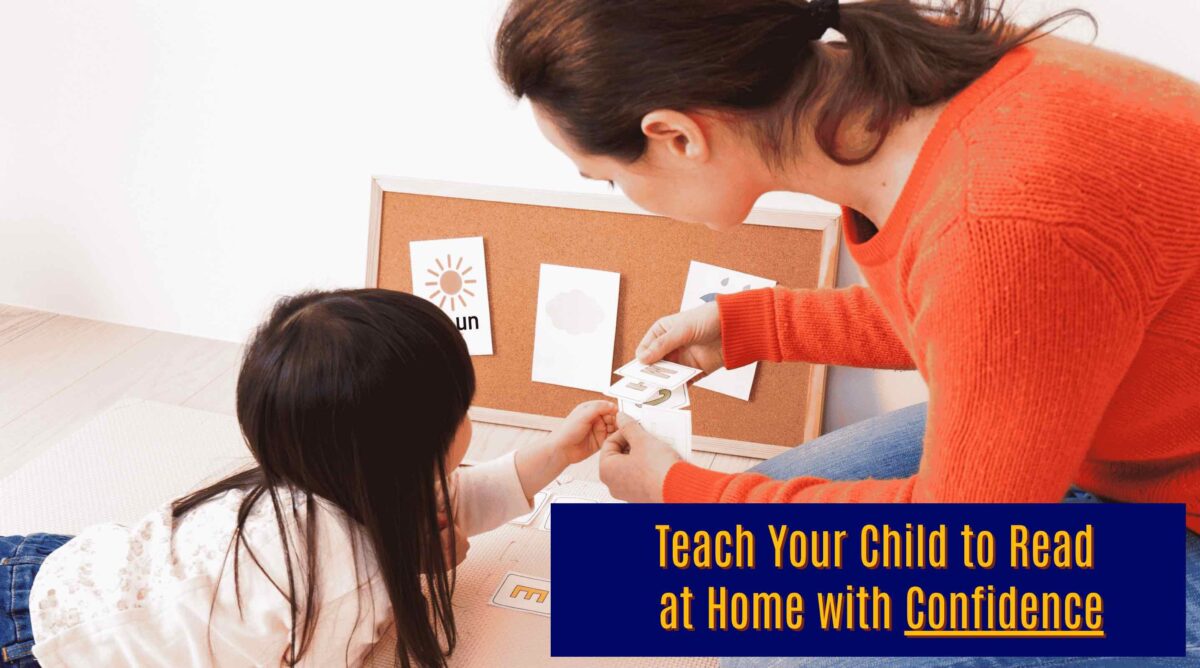
Teaching your child to read can feel overwhelming.
While there are countless reading programs, phonics curricula, apps, worksheets, and books available, most of them will give you a script to follow and/or a set of activities to complete.
Very rarely will they go into the logic behind the activities, how the process of learning to read develops, or how to adapt things to your child’s specific needs.
That kind of structure can be helpful, but what happens when you follow the steps to a tee, and your child still struggles?
This is where many parents begin to feel lost and overwhelmed.
Teaching your child to read at home is normally not as simple as finding a script and following it rigidly.
However, it is totally doable! Let’s find out how!
*Affiliate Disclosure: Some of the links may be affiliate links, meaning that I could get a small commission at no additional cost to you. This helps support the platform and allows me to continue creating free content.
Can You Really Teach Your Child to Read at Home?
Yes, parents can successfully teach their children to read at home.
In fact, you don’t need to be a trained teacher. You do not need expensive equipment, a classroom setup, or hours of formal lessons every day.
However, you need a clear understanding of what you are doing, why you are doing it, and a system that’s aligned with how the process of learning to read develops… and with your kid’s specific needs!
Those are the keys to success in teaching reading, in my opinion.
Children need to develop several connected skills, including:
- Awareness of the sounds in spoken words
- Knowledge of letters and their sounds
- The ability to blend sounds together
- The ability to read words accurately
- Knowledge of common spelling patterns
- Vocabulary
- Increasing reading fluency
These skills build upon one another.
When you understand the sequence, it becomes much easier to identify where your child is and what to teach next. Let’s go through the steps involved now.
If you’re ready to start teaching your child to read and would like more guidance along the way…
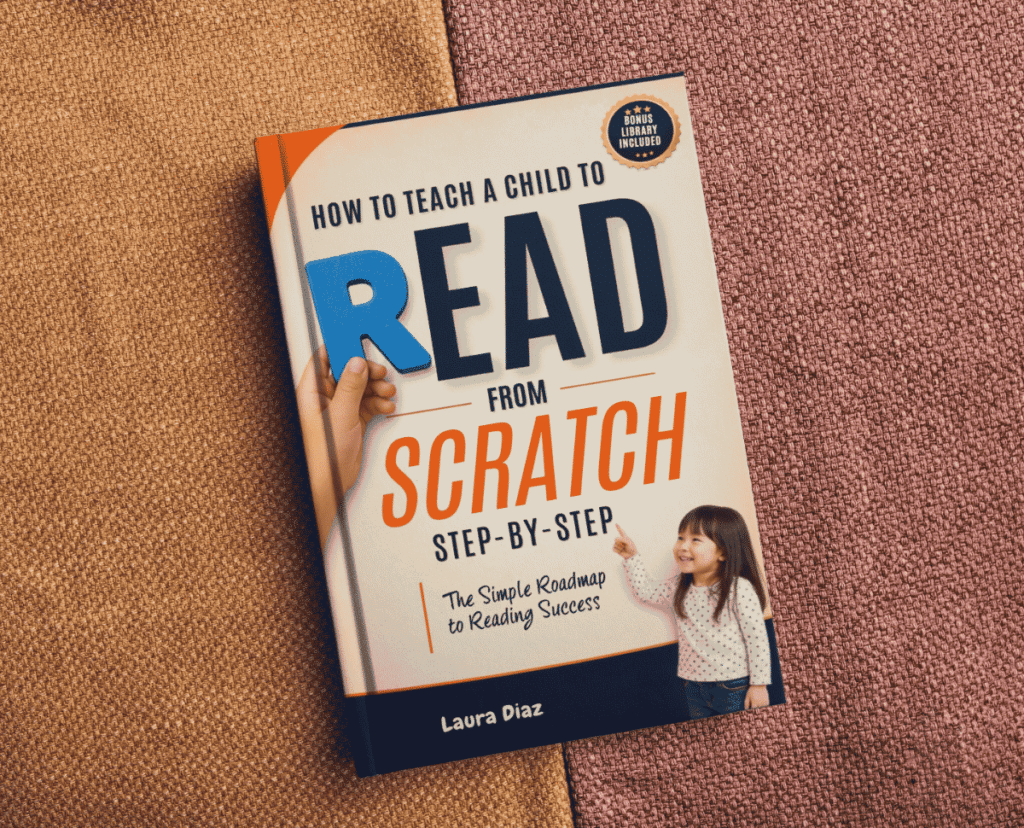
My book, “How to Teach a Child to Read from Scratch Step-by-Step,” is a great way to start!
Step 1: Make Sure Your Child Is Ready to Begin
Before formal reading instruction begins, children benefit from developing some basic reading-readiness skills.
These include:
- Enjoying books and stories
- Understanding that print carries meaning
- Listening to and following simple instructions
- Noticing rhyme and word patterns
- Recognizing some letters
- Being able to pay attention for short periods
Your child does not need to master every one of these skills before learning to read.
However, these early experiences make formal instruction much easier.
At home, you can support reading readiness by reading aloud, talking about stories, singing songs, playing with rhyme, and drawing your child’s attention to letters and sounds in everyday life.
Want to know more about Reading Readiness?
Step 2: Build Phonemic Awareness
Phonemic awareness is the ability to hear and work with the individual sounds in spoken words.
For example, a child with phonemic awareness understands that the word map is made up of three individual sounds: /m/ /ă/ /p/.
This skill is entirely auditory. It does not require written letters.
Phonemic awareness is important because children need to hear the separate sounds in words before they can connect those sounds to letters and blend them while reading.
You can practise phonemic awareness through simple oral activities such as:
- Identifying the first sound in a word
- Blending spoken sounds into a word
- Breaking a word into its individual sounds
- Changing one sound to make a new word
For example, you might say:
“What word do these sounds make: /s/ /ŭ/ /n/?”
Or:
“What is the first sound in fish?”
These activities can be playful and brief. A few minutes at a time is often enough.
Want to know more about Phonemic Awareness?
- Learn More Here!
- Download – Free Reading Worksheets Based on PHONICS and Phonemic Awareness Principles!
Step 3: Teach Letters and Their Sounds
Children need to learn that letters represent sounds. This is normally referred to as “the alphabetic principle.”
When teaching letters, focus on helping your child:
- Recognize the letter
- Say its most common sound
- Connect the letter shape with that sound
It is better to introduce letters gradually rather than the entire alphabet at once. Teaching too many letters at once usually overwhelms children, leading to cognitive overload.
On top of that, I recommend focusing on one sound per letter at a time—the most common sound for each letter. For instance, “g” for “goat,” instead of “g” for “giraffe,” or both sounds at the same time; or “c” for “cat,” instead of “c” for “circle.”
Ideally, you want to introduce letters that can quickly be combined to form simple words. This allows children to begin using their new knowledge almost immediately.
It is also important to pronounce letter sounds clearly. Avoid adding an extra “uh” sound at the end of consonants (some people talk about “clipping the sounds”).
For example, pronounce the sound for m as /m/, not “muh.”
That will make blending much easier later on.
If you want to learn more about how to “clip the sounds” you can watch this video.
I know firsthand that this can be a difficult step in the process for many children. These children need lots of repetition to learn the letter sounds. Fortunately, there are several effective strategies you can use to support them. One of my favorite tools is this one. Another excellent strategy is to use books and stories rich in alliteration, like this one.
In my book “How to Teach a Child to Read from Scratch Step-by-Step,” I go through these strategies (and others!) in further detail.
Step 4: Teach Your Child to Blend Sounds
Blending is the process of pushing sounds together to read a word. That is:
A child sees the word “map” and says:
/m/ /ă/ /p/
and then combines the sounds to say:
map
For many children, blending is the point where reading begins to feel real. It is also one of the most common areas of difficulty.
To avoid struggles, start with short, simple words containing sounds your child already knows, and model the process clearly:
m – /m/
a – /ă/
p – /p/
map
Say the sounds close together with very little pause between them several times. Go faster and faster until you end up saying the target word: “map.”
Some children learn to blend quickly. Others need more support, more modelling, or a different technique. For example, you could try continuous blending or successive blending.
If your child continues to struggle, do not assume they are not ready or that you simply need to repeat the same exercise indefinitely.
Ask yourself:
- Does my child know the letter sounds securely? Can she/he say the sound straight away without hesitation?
- Are the words too difficult? Begin with CVC words (more on that later) that contain sounds he/she has already mastered.
- Is s/he leaving long pauses between the sounds? Many kids know the letter sounds, but struggle to blend the sounds to read words, anyway. Leaving long pauses between the sounds when attempting to read can be at the root of the problem.
- Would a different blending technique help?
Understanding what may be causing the difficulty allows you to respond more effectively.
If you’re ready to start teaching your child to read and would like more guidance along the way…
My book, How to Teach a Child to Read from Scratch Step-by-Step, is a great way to start.
Step 5: Begin with Simple CVC Words
Once your child can blend, begin practicing simple consonant-vowel-consonant words, often called CVC words.
Examples include:
- cat
- dog
- sun
- map
- hen
These words are useful because they usually contain three clear sounds and follow predictable spelling patterns.

Try to choose words made only from letter sounds your child has already learned.
At this stage, encourage your child to sound out unfamiliar words instead of guessing from the picture, the first letter, or the surrounding sentence.
Pictures are wonderful for engagement or even supporting comprehension, but they should never reveal the story or help your child “guess” the word instead of reading the word.
If you want a list of CVC words, you may download one here.
Step 6: Introduce High-Frequency Words Carefully
High-frequency words are words that appear often in written text.
Some can be decoded using phonics. Others contain an unusual or not-yet-taught spelling pattern.
Rather than asking your child to memorize the whole word as a visual shape, examine the word together.
Identify:
- The parts that follow familiar sound-spelling patterns
- The part that needs to be remembered
For example, in a word with one unexpected spelling, most of the word may still be completely decodable.
Examples:
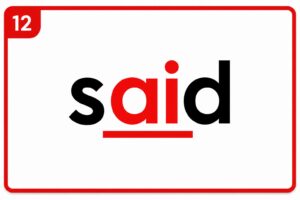
- In the word “said,” you could help your child identify that the only unexpected spelling in this word is “ai.”
- In the word “the,” the spelling “e” makes an unexpected sound (highlighted in red below), while “th” is a decodable digraph (however, most beginner readers won’t know about digraphs yet).

This approach helps children connect high-frequency words to the alphabetic system rather than treating each word as an unrelated picture.
Want to know more?
Learn about the Phonetic Approach to High-Frequency Words.
Step 7: Progress Through Phonics in a Logical Order
After your child can read simple CVC words, you can gradually introduce more complex phonics patterns.
This may include:
- Consonant digraphs such as sh, ch, and th
- Consonant blends
- Longer words
- The “Floss” Rule
- Silent e Words
- Vowel teams
- R-controlled vowels
- Soft and Hard c
- Soft and Hard g
- Advanced spelling patterns, and more.
A clear phonics sequence helps ensure that your child has the knowledge needed for each new step.

It also prevents you from moving too quickly into books or word lists containing patterns your child has never been taught.
Want to Know More?
Download my phonics sequence here.
Step 8: Use Decodable Reading Practice
Children need opportunities to apply their phonics knowledge in real reading.
Decodable books are designed around the letter-sound relationships and spelling patterns a child has already learned.
This means the child can read most of the words using phonics rather than guessing.
Choose texts that closely match your child’s current knowledge. A book can be labelled “beginner” and still contain many patterns your child has not learned yet.
In fact, not all beginner readers’ books are considered “decodable books.” Learn the differences between decodable and levelled books here.
The aim is to work on your child’s decoding skills, and build accuracy, confidence, and understanding.
If you’re ready to start teaching your child to read and would like more guidance along the way…
My book, How to Teach a Child to Read from Scratch Step-by-Step, is a great way to start.
Step 9: Keep Reading Aloud to Your Child
Once formal reading instruction begins, do not stop reading aloud.
Children can understand stories and vocabulary that are far more advanced than the books they can read independently.
Reading aloud helps develop:
- Vocabulary
- Background Knowledge
- Comprehension
- Listening Skills
- A positive relationship with books
Your child’s reading practice and your read-aloud time serve different purposes, but both are important.
Step 10: Keep Lessons Short and Consistent
Teaching your child to read at home does not require long daily lessons.
Short, focused sessions are often more effective, especially for younger children.
You might spend time on:
- A phonemic-awareness activity
- Reviewing letter sounds
- Practizing one new skill
- Reading a few words
- Reading a short decodable text
The exact length will depend on your child’s age, attention span, and confidence.
Consistency matters more than duration.
Ten calm, productive minutes can be far more valuable than a long lesson that ends in frustration.
What If Your Child Gets Stuck?
This is one of the most important questions a parent can ask.
Children do not all learn at the same pace. They do not struggle with the same skills, and they do not always respond to the same explanation.
When something is not working, avoid simply repeating the same activity in the same way.
Instead, try to identify the problem.
For example:
- If your child forgets letter sounds, they may need more practice connecting the letter with a memorable image, story, gesture, or keyword.
- If your child knows the sounds but cannot read words, they may need more phonemic-awareness or blending practice.
- If your child reads short words but struggles with longer ones, they may need help breaking words into smaller parts.
- If your child guesses words, the reading material may contain patterns they have not yet learned.
- If your child becomes frustrated quickly, the activity may be too difficult, too long, or moving too fast.
The Most Important Thing Parents Need
The most useful thing you can have when teaching your child to read at home is not necessarily a perfectly worded lesson script. It is a clear roadmap.
You need to understand:
- Where reading instruction begins
- How the skills build on one another
- What your child should learn next
- What common difficulties look like
- What alternatives you can try when progress stalls.
That understanding allows you to teach with greater confidence and achieve better results.
This is exactly why I created How to Teach a Child to Read from Scratch Step-by-Step.
The book takes parents through the full process, beginning with early reading readiness and continuing through the skills generally associated with fluent early reading.
Teach Your Child to Read With Confidence
From First Sounds to Fluent Reading following a flexible framework you can adapt to your child’s specific needs

Hey there! I’m Laura – an author, YouTuber, blogger, and the creator of the “Learning Reading Hub” platform. I created this space to dive into the world of reading instruction and to shout from the rooftops about how vital it is to use the right methods for teaching reading. I’ve got a TEYL certification (Teaching English to Young Learners), plus a Journalism degree from the University of Navarra in Spain, along with a Master’s Degree in Communication.
I’ve always loved digging into research, jotting down my thoughts, connecting with people, and sharing what makes me tick. With a background in marketing, digital projects, and the education scene (especially language learning), I’m all about wearing different hats.
When my first kid needed to learn how to read, it opened my eyes to the challenges and complexities involved. This journey took me through a rollercoaster of self-teaching, eye-opening discoveries, and yeah, some letdowns too. There’s so much conflicting info out there, along with methods that just don’t cut it. And let’s face it, these issues are way too common.
Now, I’m all about channeling that passion (without sounding like a know-it-all!) and sharing my journey. My mission? Making it easier for those who are on the same path I once was.
My heart’s with my family and the amazing Learning Reading Hub project. I live with my husband and two little ones, raising them in a bi-lingual environment (English and Spanish).
