

Montessori uses systematic synthetic phonics for teaching reading.
Children are introduced to the sounds of letters and phonograms through various activities and materials. However, there are a few peculiarities to how the Montessori system teaches reading that makes it pretty special and unique!
Let’s go through them!
*Affiliate Disclosure: Some links lead to Amazon marketplace. As an Amazon associate, I earn from qualifying purchases, at no additional cost to you). There may be additional affiliate links. This helps keep the information on the blog free and available to everyone.
Peculiarity #1: It teaches writing before reading.
Montessori teaches writing before reading or how to decode. This approach is considered organic, because -according to Montessori-, the ability to write comes first and more naturally than the ability to blend sounds and read words.
Why is writing considered a natural and logical precursor to reading?
Maria Montessori observed a phenomenon she termed an “explosion into writing” that happens before reading.
In fact, it occurs even before the child can ever read what he/she has written.
When I first read about this phenomenon, it made perfect sense to me! I vividly remember how my youngest daughter at age four used to draw letters and letters in whiteboards, pieces of paper, to then ask me: What did I write? What does it say here?
She used to do this a lot, and I found it extremely funny.
Most times those sequence of random letters meant nothing at all. However, that showed she was fascinated by the concept of how those symbols that we call letters represent words you can read out loud. She was definitively going through that “explosion into writing” Maria Montessori observed.
Other times, she would just write down her name, and felt extremely proud when I told her that she had written her own name. Then, we would go over every letter in her name, and see how the letters connected to the sounds in her name.
While very prolific with her writing at that point, she was not yet ready to read or sound out words, as she was still unable to connect most letters to their sounds.
My own personal observation.
Another reason as to why Montessori starts with writing before reading is the importance that the Montessori system places on sensorial experiences to facilitate learning. Writing makes the learning-to-read process more tangible and meaningful.
Montessori education follows a progression from concrete to abstract concepts.
In the case of literacy, children start by working with concrete materials like sandpaper letters, moveable alphabets, and metal insets. These materials allow children to physically explore something abstract (sounds) via concrete materials that support the use of writing as a foundation for learning to read.
It’s important to note that while Montessori introduces writing before reading or decoding, reading skills are also gradually introduced and developed alongside writing. The goal is to provide a holistic and integrated approach to literacy, where children develop both reading and writing skills in a meaningful and interconnected way.
Peculiarity #2: There don’t seem to be Montessori literacy curricula, as such.
Please correct me if I’m wrong here, but what I see you have, if you want to follow this route, are more courses that introduce you to the world of Montessori, and give you recommendations, so you can create your own homeschooling curriculum, specific to your child’s needs.
Of course, you also have Montessori Guides and books, and of course Montessori materials that have been specifically created for teaching reading.
In the sources section down below, I will leave you a few links to interesting reads about the Montessori system.
In that regard, there are three key materials that Maria Montessori relied on for teaching reading, and these are the materials that you are going to use as well if you want to teach your child to read “the Montessori way”:
Material 1: Sound Objects for Phonemic Awareness.
That is, to develop your child’s ability to hear and manipulate the individual sounds in the language.
The way you go about it in Montessori is by playing the “I spy” game with these sound objects.
You know how it goes: You say “I spy with my little eye something that starts with /s/ or /p/,” or whatever sound you pick. Just remember to say the sounds, not the letter names! You have these objects in front of your child and he/she has to pick the one that starts with that sound.
No products found.

- Sound objects mystery box!
- Pull out one item at a time and match it to the letter where it belongs.
- Learn sounds, words and letters!
Material 2: Sandpaper letters for connecting letters and sounds.
They look like this, and allow your child swipe his/her fingers along the form of the letters.
The idea is that this sensorial experience helps children internalize the shape and sound of each letter.

Material 3: Moveable alphabet for writing full words before children master how to write with a pen.
Movable alphabets are sets of small wooden or plastic letters that children can manipulate to form words.
Again, the idea is to engage the senses to facilitate learning.

- MONTESSORI INSPIRED: The Montessori & Me Movable Alphabet is a classic Montessori material often used for teaching writing, reading and spelling. Its versatility makes it the perfect tool for common literacy activities such as beginning letter sounds, object matching and storytelling.
- HANDS-ON LEARNING: The Movable Alphabet is an incredibly powerful tool that allows children to express themselves with “written” language at an early age, long before they have developed the fine motor skills required to use a pen or pencil. Give your child the freedom to start writing!
- DUAL PURPOSE WOODEN CASE: The Montessori & Me Movable Alphabet features a dual-purpose wooden case. Just flip open the wooden lid to reveal three rows of painted ruling lines, ready for your child’s letter placement! This clever design allows the lid to double as your child’s work space and helps with development of letter spacing and alignment.
- QUALITY & LONGEVITY: You can expect this quality-built Movable Alphabet to last through the preschool years and beyond! The included strong and durable case is crafted from an eco-friendly hardwood and finished with a smooth, lasting child-safe lacquer to protect and organize your educational investment.
- SAFETY GUARANTEED: As with all Montessori & Me materials, this Movable Alphabet has passed rigorous compliance testing at a CPSC-Accepted laboratory and conforms with all federally regulated safety standards, ensuring that this material is 100% baby and kid-safe!

- 20 cards for each vowel and high frequency letter (r,s,t,n) and 10 cards for each other letter
- Can be used alone or with the green phonogram alphabet (sold separately)
- Cards (approx. 1.25″ x 2″) have rounded corners to acknowledge the tactile sensitivities of those small hands
- Fully laminated with a food-grade, US-made laminate
- Fits into an egg-carton or a craft box (sold separately)

- Includes 20 of each vowel, 20 each of the high frequency consonants n, r, s, and t, and 10 each of all other consonants…plenty of letters to write everything they like!
- Fully laminated with rounded corners (to acknowledge the tactile sensitivities of those small hands)
- Cards are approx. 1.25″W x 2″H and are eco-printed on only one-side (to isolate the difficulty)
- Fits into egg-cartons or a craft box.
By physically arranging the letters in these movable alphabets to form words, children develop a concrete understanding of the relationships between letters and sounds.
It’s very likely that you’ve also heard of the use of metal insects in the Montessori system.
Are they use to teach reading?
Not specifically, but they can surely help with your child’s pre-reading skills. These metal insets help children develop fine motor skills and hand-eye coordination, which are essential for writing.
By working with these materials, children also gain dexterity familiarity with the movements required for forming letters.
Peculiarity #3: The system Maria Montessori developed was to teach how to read Italian.
These materials were all Maria Montessori needed to teach reading, but the system she developed was to teach how to read Italian.
The Italian phonetic code is way simpler than the English one. In fact, I’ve even heard that it’s the easiest language when it comes to learning to read. Children can learn in a few months!
I know it sounds crazy! How can this be? Italian is very regular/very transparent. Every letter represents only one sound, and sounds are represented always in the same way, and besides, exceptions to the norm are really rare.
If you don’t believe me, I read it in a book from a very eminent researcher. The book is called “Reading in the Brain,” by Stanislas Dehaene.
So, Maria’s original reading program, while probably very good for the initial stages of learning to read -I can totally see that, as Montessori uses a great combination of activities and materials that engage all of the senses to develop Phonemic Awareness from an early age, to learn the connections between letter and sounds and to enhance children’s motor skills-, it is probably not going to be enough for dealing with all the complexities of the English system.
Apparently, his son Mario Montessori said:
So, the English-speaking world had to find solutions to fill the gaps. Most of the solutions that are used right now were proposed by a teacher trained on the Montessori system called Muriel Dwyer.
This system is explained on the book “A Path for the Exploration of Any Language Leading to Writing and Reading,” which would probably be your go-to guide for teaching reading English according to Montessori principles.
As we move on to the next stages of learning to read, beyond the materials and activities I previously discussed (which were the only ones Maria Montessori needed to teach reading in Italian – considering the simplicity of the Italian spelling system compared to English), there are additional elements and materials to explore.
For instance:
Matching objects and cards
With this type of 3-part cards children read a word label, match it to the picture-only card, and later can use the control card to check out if they picked the right answer. These awesome cards also allow children build vocabulary and to work independently. If you are working with an emerging reader, you can just use the image cards, to help them build up their vocabulary (having a rich vocabulary is an essential piece of the puzzle for becoming a successful reader in the future)

- Five packets (6 images/18 cards per packet) so you can keep changing things up to maintain interest; 90 cards total
- 3-part format includes photos, labels, and control cards (word and label put together)
- Rounded corners (no pricked fingers or dog-eared cards)
- Each packet comes in a sturdy, clear reclosable bag for storage
- Lesson plan included
Phonetic word cards
After your child knows letter and letter sounds, and has worked with the Movable Alphabet and the Phonetic Object Box, you can start to introduce phonetic word cards that contain simple three-letter words with short vowels (CVC words).
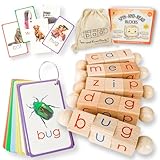
- LEARN TO READ: New readers will learn how to read and rhyme with our movable CVC word builder blocks & matching phonics flash cards. Letter combos in this set have been carefully chosen to maximize the # of common decodable CVC words for preschoolers. This set teaches the base standard of reading using 3-letter words. There are no sight words or words that don’t follow the normal letter sounds; this encourages children as they are able to easily sound out any of the words our rods create.
- TACTILE PRE-K & KINDERGARTEN LEARNING MATERIAL: Rotating wooden letter blocks create 60+ 3-letter words. Each of the 5 wooden rods features one vowel and a set of consonants that rotate. Along with our animal alphabet letter sounds guide children will see how easy and quick it is to read with this fun spinning phonics toy.
- DESIGNED FOR SELF-CORRECTION & EMPOWERMENT: 30 double-sided CVC flashcards with real-life images = a versatile Montessori reading material. Cards are designed for exploration & correction – one side has the picture, the other side includes the picture with the word. This design can be used for different stages of learning and allows kids to create the word on their own before checking its accuracy. Cards are color-coded by vowel as well and allow for fun games and letter pattern recognition.
- A TRAVEL-FRIENDLY MONTESSORI TOY FOR TODDLERS & PHONICS WORKSHEET SET: This travel toy is designed for easy learning on-the-go and is a great kindergarten classroom must-have! Phonics flashcards are ring-bounded and a tote bag = easy clean-up. This set makes for a great gift for kids 3-6 years old. It even comes with phonics game ideas and a downloadable 25-page phonics worksheet set for more practice.
- ECO-FRIENDLY, DURABLE, & SAFE: All our wood toys are 3rd-party certified non-toxic & kid-safe; this toy is made of solid beechwood, which is more durable than other cheaper woods. Our toys exceed all child safety regulations in the USA, UK, the EU, Canada, Australia, New Zealand, & Japan. Fully designed by a mom of young kids who deeply cares about ethics and safety.
Phonetic activity cards or action word cards
These cards have easy-to-decode action words, such as run, clap or hug, that are easy and fun to act out!
Puzzle word cards.
This is another name for irregular high-frequency words.
Phonogram cards and folders.
All of these materials will allow you go ahead and execute Montessori activities, lessons and games for learning to read.

- Set of 16 sandpaper letter combinations on green wooden boards: ai, ar, au, ch, ee, er, ie, oa, oo, or, ou, oy, qu, sh, th, ue.
- This is a tactile activity, the child guides their hand to trace their fingers along the sandpaper surface that shapes each letter in the precise style and direction that each would be written.
- As an extension activity, when the child is ready, the letter cards can be combined to help the child to begin to form simple familiar words.
- X-sandpaper:10.2*7.5*0.1 in,S-sandpaper:8.7*4.7*0.1in

- Choose from any of our three Montessori fonts (to match your sandpaper letters)
- Fully eco-laminated with rounded corners to acknowledge the tactile sensitivities of those small hands
- All letters are printed on only one side to isolate the phonogram
- Includes 10 of each of 17 phonograms (ai as in paint, ar as in yarn, au as in Paul, ch as in chip, ee as in tree, er as in fern, ie as in pie, ng as in king, oa as in boat, oo as in book, or as in corn, ou as in cloud, oy as in boy, qu as in quick, sh as in ship, th as in moth, ue as in blue)
- Comes with a powerful lesson plan that will bring the alphabet work to life
Peculiarity #4: Individualized Instruction.
Even if you are in a Montessori classroom setting the materials and methods used will allow for individualized instruction, meaning that children will be able to progress at their own pace.
This is purposefully in this way, so children receive the support and guidance appropriate that is appropriate for their needs and abilities.
In other words, children are challenged and engaged in their learning in a way that makes sense for them. The idea is that this approach will help them progress at their own pace, but also will build up their self-esteem and a positive attitude towards learning.
Besides, individualized instruction recognizes that children have unique strengths, interests, and learning styles.
This could be another reason why Maria Montessori was also so fond of the phonics approach to teaching reading. The phonetic nature of language, understood through Montessori education, allows children to apply this knowledge to both reading and writing.
The phonetic approach empowers children to become independent readers and writers. By teaching them how to decode and encode words, children can engage with written language on their own, by applying what they know to sound out words in text, or even attempt to spell words based on the sounds they hear (as opposed to memorizing word lists).
This independence and confidence lay a strong foundation for lifelong literacy skills.
Peculiarity #5: Language activities to facilitate vocabulary acquisition.
While not exclusive to the Montessori system, it is worth noting that there’s a clear emphasis on creating a rich language environment right from the early stages. This environment promotes vocabulary acquisition, sentence structure and grammar.
Some of the activities used are storytelling, conversations, and language games.
Sources for this article and/or for further reading:
- Montessori, M. (1948). The Discovery of the Child.
- Lillard, A. S. (2008). Montessori: The Science Behind the Genius.
- Dehaene, S. (2010). Reading in the Brain: The New Science of How We Read
- Dwyer,M.(2004). A Path for the Exploration of Any Language Leading to Writing and Reading

Hey there! I’m Laura – an author, YouTuber, blogger, and the creator of the “Learning Reading Hub” platform. I created this space to dive into the world of reading instruction and to shout from the rooftops about how vital it is to use the right methods for teaching reading. I’ve got a TEYL certification (Teaching English to Young Learners), plus a Journalism degree from the University of Navarra in Spain, along with a Master’s Degree in Communication.
I’ve always loved digging into research, jotting down my thoughts, connecting with people, and sharing what makes me tick. With a background in marketing, digital projects, and the education scene (especially language learning), I’m all about wearing different hats.
When my first kid needed to learn how to read, it opened my eyes to the challenges and complexities involved. This journey took me through a rollercoaster of self-teaching, eye-opening discoveries, and yeah, some letdowns too. There’s so much conflicting info out there, along with methods that just don’t cut it. And let’s face it, these issues are way too common.
Now, I’m all about channeling that passion (without sounding like a know-it-all!) and sharing my journey. My mission? Making it easier for those who are on the same path I once was.
My heart’s with my family and the amazing Learning Reading Hub project. I live with my husband and two little ones, raising them in a bi-lingual environment (English and Spanish).
