
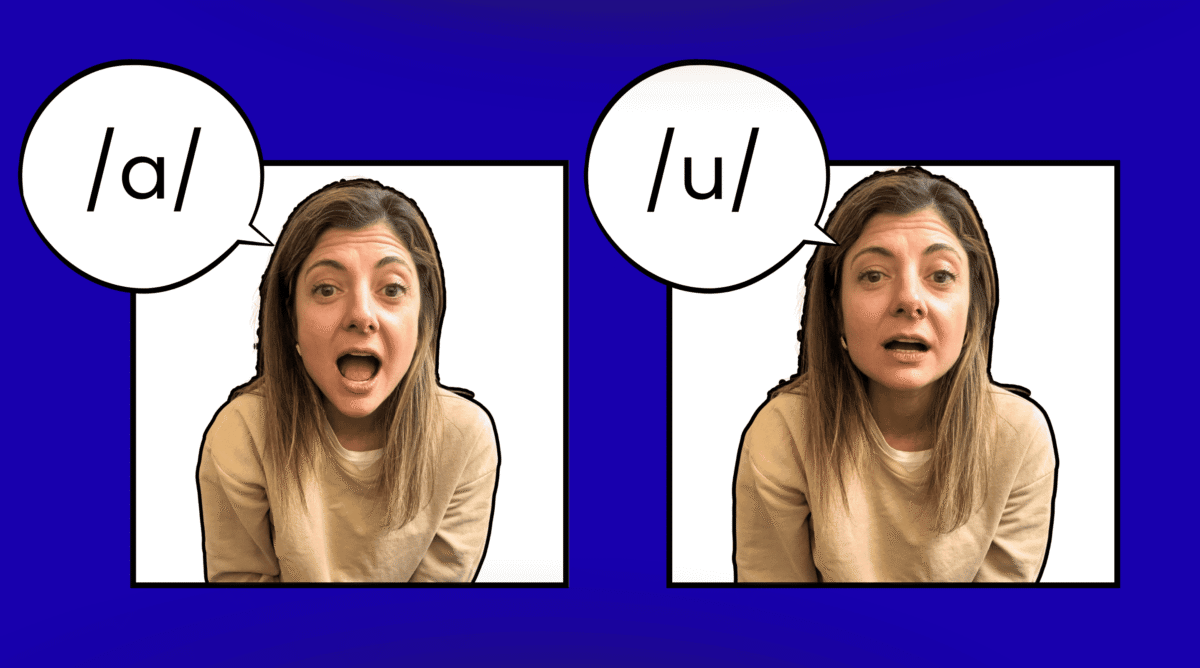
English vowels are tricky.
Most people think English has five vowels: a, e, i, o, u (and sometimes y). Simple enough, right?
Well, not exactly!
English actually has around 20 vowel sounds, depending on the accent. Compare that to:
- Spanish (5 vowel sounds)
- Japanese (5 vowel sounds)
- Italian (around 7 vowel sounds)
That’s a big jump, and it helps explain why English vowels can feel overwhelming.
Today we’re focusing on two that cause a surprising amount of confusion:
- /a/ as in cat
- /u/ as in cut
Why do English Learners Confuse /a/ and /u/?
In many languages, there simply isn’t a contrast between these two sounds.
Take Spanish as an example. It has one clear “a” sound. Both English /a/ (cat) and /u/ (cut) often get mapped onto that same vowel category: the Spanish /a/ sound.
In other words, if the brain doesn’t have two separate “boxes” for those sounds, it’s likely they will get stored together.
So words like:
- cat / cut
- bag / bug
- fan / fun
- hat / hut
sound identical to these ESL students.
When you can’t clearly hear the difference, you can’t reliably produce the sounds either.
Fun Fact: Your Brain Sorts Sounds into Categories
This confusion isn’t strange… it’s how the brain works!
Our minds don’t hear every tiny acoustic detail. Instead, they sort sounds into categories based on our first language.
For example, Japanese does not strongly distinguish between the English /r/ and /l/ sounds. So words like “right” and “light” can sound very similar to Japanese learners at first. Their brain places both sounds into the same category.
This phenomenon is called categorical perception.
It’s exactly the same phenomenon we see with vowel sounds.
If a language doesn’t clearly separate /a/ (cat) and /u/ (cut), the brain may group them together, and they genuinely sound the same to these students.
Don’t despair though!
With the right training, the brain can build up new sound categories…
I know this from personal experience! This probably explains why I am such a fan of phonemic awareness, both in literacy and in second language learning… The very first step of the training is developing the ability to hear and discriminate sounds!
In second-language research, this idea is supported by the Perceptual Assimilation Model (PAM), proposed by psychologist Catherine Best in the 1990s.
According to this model, when we hear sounds from another language, we automatically “assimilate” them into the closest sound categories from our first language.
If two English vowel sounds both map onto a single native-language category, learners will initially perceive them as the same sound, even if they are acoustically different.
In other words, the brain is doing what it always does: simplifying and organizing.
But This Confusion Isn’t Just an ESL Issue…
Even some native English-speaking children confuse these two sounds when learning to read and write.
Now, most native speakers can distinguish /a/ (cat) and /u/ (cut) naturally in speech.
So what could explain this confusion in early readers?
One plausible explanation (a hypothesis by Australian speech pathologist Alison Clarke*) is that it relates to how children first encounter the letter “a.”
One of the very first words children learn to read is the article “a.”
But in everyday speech, we usually pronounce it as “uh.”
So a child may logically infer: “The letter ‘a’ says /u/.”
From there, it makes perfect sense for them to read:
- bat as but
- fan as fun
When you think about it this way it’s not strange at all… It’s actually completely logical.
The Hidden Player in the “a” and “u” Confusion: The Schwa Sound
On top of that, English is full of unstressed vowels (represented by the letter “a”) that sound very much like the /u/ sound in “cut.”
This sound is called schwa (/ə/), and you have probably heard of it before, as it’s the most common vowel sound in English.
The schwa sound sounds very similar to /u/ (as in cut), but softer and quicker. It’s a “reduced” sound, as it always happens in unstressed syllables.
Here are common examples where the letter a is pronounced as schwa:
- about
- around
- again
- above
- along
- banana
In all of these, the letter “a” does not say /a/ like in cat. It says that soft, reduced “uh” sound (the schwa sound).
Over time, children hear this pattern repeatedly and conclude, once again:
“The letter ‘a’ often sounds like ‘uh.'”
If you want to learn more about the schwa sound, you may want to check this article.
What’s the Actual Difference Between the /a/ and /u/ Sounds?
Helping learners see and feel the difference can make a big impact.
/a/ as in “cat”
- Mouth wide open
- Tongue low and forward
- Visible tongue
- Like when the doctor says: “Say ahhh!”
You can stretch it:
ca-aaaat
/u/ as in “cut”
- Mouth less open
- Tongue slightly pulled back
- More relaxed sound
Harder to stretch:
cuuuut feels unnatural.
That stretchability difference can be used as a teaching clue.
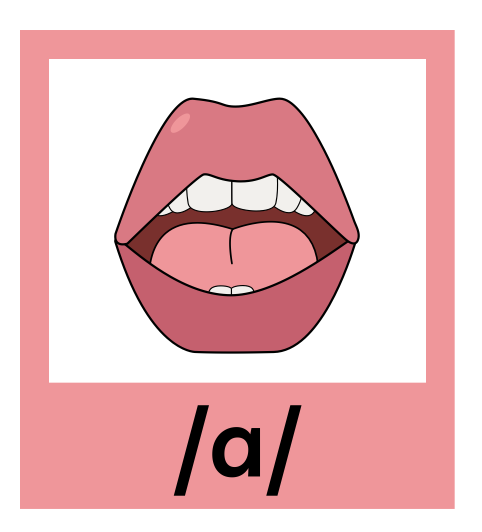
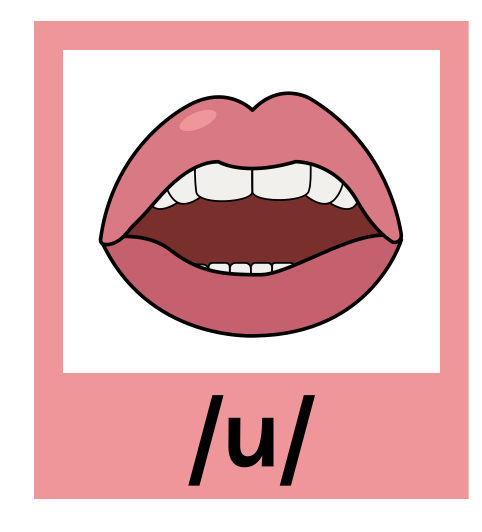
Download mouth position posters (for short and long vowel sounds) here!
Practical Activities for the /a/ and /u/ Confusion (For ESL and Native Speakers)
#1: Mirror Work
Give your students a handheld mirror.
Then, ask them to produce the sounds while looking at themselves in the mirror.
Have them say:
- /a/
- /u/
Articulation awareness strengthens sound discrimination.

#2: Recording and Listen Back
Another powerful tool is recording your own voice.
Have learners record themselves saying the sounds, and words containing the target sounds. Then, have them listen back carefully.
If you are doing this to work on your own pronunciation, it can feel pretty awkward at first. However, hearing yourself objectively is incredibly helpful.
#3: Using Bone-Conduction Headphones
One tool I personally find fascinating for pronunciation work is using bone-conduction headphones.
Unlike traditional headphones, they transmit sound through the skull. When you speak while wearing them, you get immediate feedback that is closer to how others hear your voice, not just how it sounds inside your own head.
That feedback can make subtle differences, like /a/ versus /u/, much easier to notice.

I’ve made a full article explaining how these powerful headphones work and the different learning applications they have, if you’d like to explore this tool further.
#3: Minimal Pair Practice
Minimal pairs are words that differ by only one sound. For example, “cat” and “cut,” or “bag” and “bug.”
Here’s a simple game you can do using minimal pair flashcards, like the ones below:
- Place two flashcards in front of the learner and say one word. They choose the correct card.
- For increasing difficulty, say the words faster.
This strengthens the mental separation between the two vowel categories.
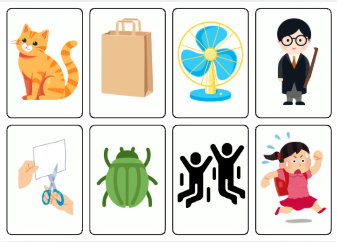
Minimal Pairs Included in the Flashcards:
cat, cut
bag, bug
fan, fun
Harry, hurry
cap, cup
cab, cub
hat, hut
match, much
*A Note on Accent Differences
The “Harry vs. Hurry” minimal pair (included in the flashcards) works for British English speakers only.
In American English, “Harry,” and “hurry” sound the same. In fact, they sound exactly like the word “hairy.”
They are all homophones (words that sound the same, have different meanings, and are spelled differently).
#4: Dictation
After explicitly working on the articulation differences for both sounds, you may:
- Dictate words with the /a/ and /u/ sounds.
- Divide a sheet of paper in two columns. Label each column: “a” and “u.” Then, dictate minimal pair words, and have them write the words in the correct column.
This is a great exercise for ESL and native English students alike!
Final Thoughts
Before children can map sounds to letters reliably, they need to clearly perceive those sounds as separate. This is exactly why phonemic awareness matters so much.
If two vowel sounds live in the same mental “box,” problems like /a/ and /u/ confusion can easily happen.
But with the right training, students can overcome these challenges.
Prefer to Watch?
Video version for this article available. Watch below!
References:
https://www.spelfabet.com.au/2014/02/a-and-u-vowel-contrasts
https://pmc.ncbi.nlm.nih.gov/articles/PMC8020593

Hey there! I’m Laura – an author, YouTuber, blogger, and the creator of the “Learning Reading Hub” platform. I created this space to dive into the world of reading instruction and to shout from the rooftops about how vital it is to use the right methods for teaching reading. I’ve got a TEYL certification (Teaching English to Young Learners), plus a Journalism degree from the University of Navarra in Spain, along with a Master’s Degree in Communication.
I’ve always loved digging into research, jotting down my thoughts, connecting with people, and sharing what makes me tick. With a background in marketing, digital projects, and the education scene (especially language learning), I’m all about wearing different hats.
When my first kid needed to learn how to read, it opened my eyes to the challenges and complexities involved. This journey took me through a rollercoaster of self-teaching, eye-opening discoveries, and yeah, some letdowns too. There’s so much conflicting info out there, along with methods that just don’t cut it. And let’s face it, these issues are way too common.
Now, I’m all about channeling that passion (without sounding like a know-it-all!) and sharing my journey. My mission? Making it easier for those who are on the same path I once was.
My heart’s with my family and the amazing Learning Reading Hub project. I live with my husband and two little ones, raising them in a bi-lingual environment (English and Spanish).
