
Adding suffixes to words in English can feel confusing at first. Sometimes letters disappear, sometimes consonants double, and sometimes spellings change in unexpected ways.
However, it’s not all unexpected or illogical… Not at all!
Below are 7 spelling rules for adding suffixes in English, explained step by step with examples.
However, first things first…
What is a Suffix?
A suffix is a letter or group of letters added to the end of a word to change its meaning. For example:
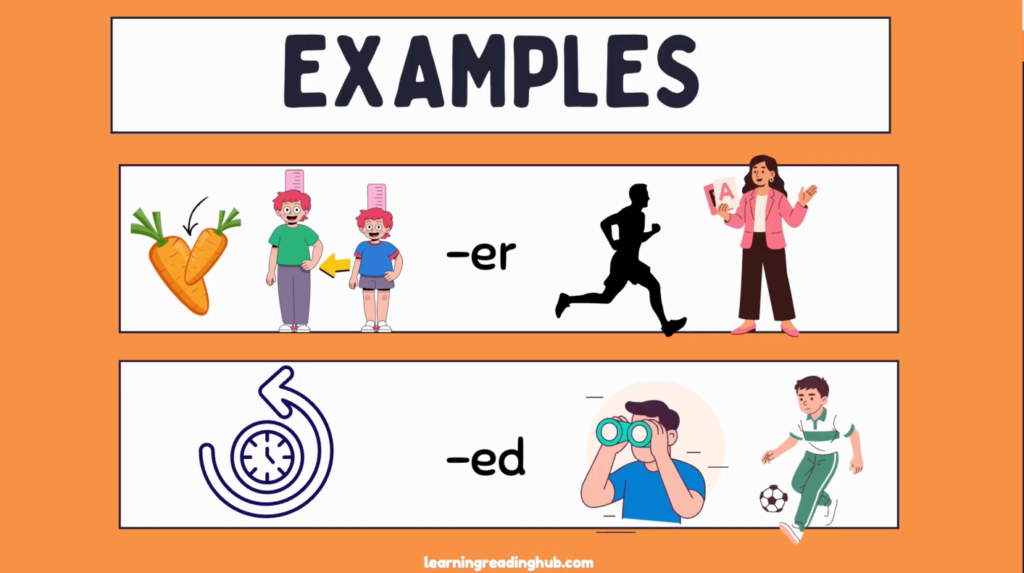
-er can mean “more,” as in bigger or taller, or a person who does something, as in runner or teacher.
-ed shows that something happened in the past, like looked or played.
Consonant VS Vowel Suffix
When learning and applying some of the rules we are going to through today, it will be essential to differentiate between vowel and consonant suffixes.
Vowel suffixes begin with a vowel letter:
- -ing
- -er
- -ed
- -y
Consonant suffixes begin with a consonant letter:
- -ly
- -ship
- -ful
- -less
This distinction is very important.
Rule 1: Final E and Suffixes
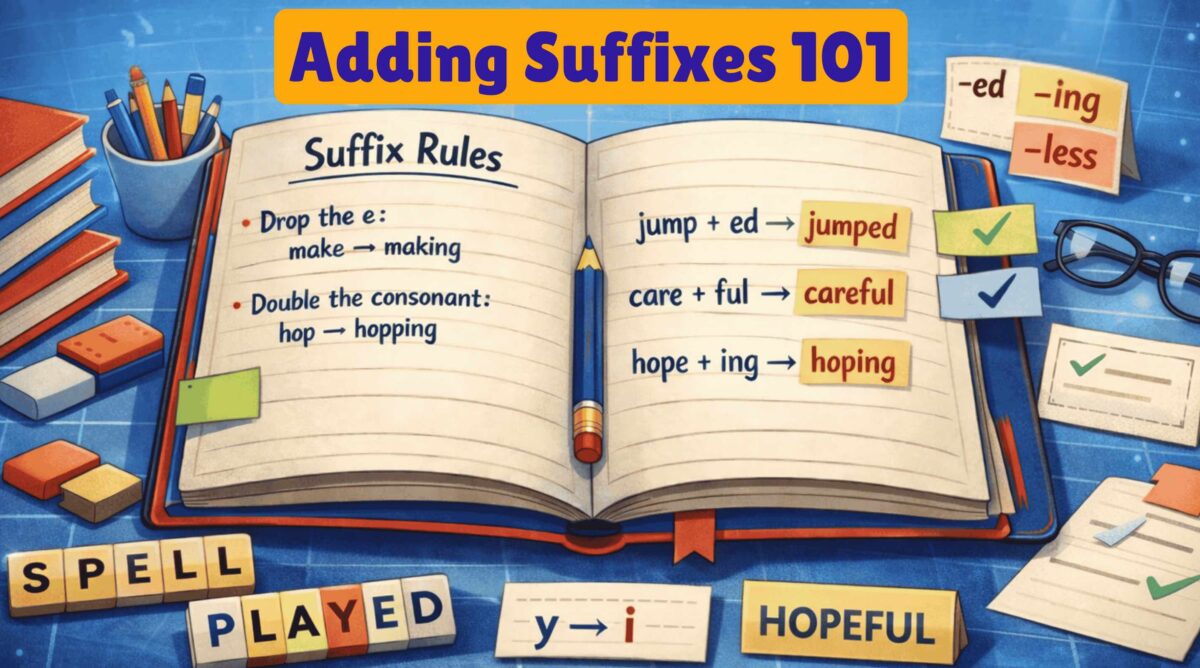
Rule: When adding a vowel suffix to a Silent Final E word, the final “e” is dropped.
So, we drop the final silent e in words like:
- make → making
- hope → hoping
- write → writing
While we keep it in words like:
- hope → hopeful
- care → careless
Special Case: Letters “C” and “G”!
If the “e” is needed, it won’t be dropped. This happens when we want to preserve the soft sound of the letters “c” or “g.”
For example:
- change → changeable
- courage → courageous
What would happen if we dropped the letter “e” in these words?
If we dropped the “e” in the base words (change/courage), the letter “G” would be pronounced /g/ (as in goat), instead of /j/ as in giraffe.
HARD VS SOFT SOUNDS OF C AND G Hard and soft C and G refer to the different sounds these letters can make depending on the vowel that follows them.
The letter “c” is usually hard (/k/) before a, o, or u (cat, corn, cup) and soft (/s/) before e, i, or y (city, cent, circle). Similarly, “g” is usually hard (/g/) before a, o, or u (game, go, gum) and soft (/j/) before e, i, or y (gem, giant, gym).
Rule 2: To Double or Not to Double the Final Consonant (CVC Rule)
Rule: When a word ends with a consonant, a vowel, and a consonant, double the final consonant, when adding a vowel suffix.
This rule applies to one-syllable words, and multisyllabic words (more than one syllable words) with stressed final syllable.
So, these are the two conditions we are looking for to double final consonant:
- The word ends in consonant–vowel–consonant (CVC)
- The suffix begins with a vowel
Examples:
run → running
hop → hopping
big → bigger
Find the rule confusing? Let’s break it down!
| WORD | CONSONANT | VOWEL | CONSONANT | SUFFIX | VOWEL SUFFIX (Y/N) | WORD WITH SUFFIX |
| Chop | YES | YES | YES | -ing | YES | Chopping |
| Big | YES | YES | YES | -er | YES | Bigger |
| Small | NO | NO | YES | -er | YES | Smaller |
| Red | YES | YES | YES | -ish | YES | Reddish |
| Fast | NO | NO | YES | -en | YES | Fasten |
| Dark | NO | NO | YES | -est | YES | Tallest |
| Wet | YES | YES | YES | -ly | NO | Wetly |
| Right | YES | NO | YES | -ful | NO | Rightful |
| Sun | YES | YES | YES | -less | NO | Sunless |
| Mud | YES | YES | YES | -y | YES | Muddy |
You may also want to take a look at this video, where I share step-by-step how the rule works!
By the way, video notes and practice worksheet for this rule are available here!
Important Reminder:
This rule applies to one-syllable words, and multisyllabic words with a stressed final syllable. For example:
begin → beginning
As the stressed syllable is the final one: begin.
But…
visit → visiting
Stressed syllable is the first one: visit.
These rules are sometimes referred to as:
The 1:1:1 Rule (1 syllable, 1 vowel, 1 consonant)
The 2:1:1 Rule (2 syllables -final must be stressed-, 1 vowel, one consonant)
However, I think this is an oversimplification of the rule, which can lead to spelling mistakes.
That would be the case for all one-syllable words with vowel teams, such as “meet,” or “team.”
These words would tick yes for all requirements in the 1:1:1 rule, leading to spelling mistakes like double “t” in meet when adding the suffix “-ing” (meetting!), or on double “m” in team when adding the suffix “-ing” (teamming!).
It’s way more reliable to look at final consonant-vowel-consonant.
Rule 3: Words Ending in Y (Change Y to I)
Rule: When the last letter of a word is “y,” and we add a suffix, the “y” is usually replaced by “i.”
For example:
- Funny (suffix: er) → funnier
- Library (suffix: -an) → librarian
This rule does not apply when:
- Adding the suffix -ing (crying),
- There’s a vowel before the letter -y (plays, boys).
Rule 4: Adding -s or -th to Words Ending in I AND Y (Add E)
This is an extension of the previous rule, really.
Rule: When the suffixes we are adding to “y” ending words are either “-s” or “-th,” we must add “e” after “i.”
For example:
- Try (suffix: -s) → tries
- Party (suffix: -s) → parties
- Fifty (suffix: -th) → fiftieth
Rule 5: FE ending Words When Adding the Plural Suffix –S
Rule: Most “fe” ending words change spelling when pluralized to “v +es.”
Examples:
- wife → wives
- knife → knives
- life → lives
IMPORTANT: While some words that only end in “f” also follow this rule (leaves, thieves, wolves), in general it only applies to words that end in “fe.”
- roof → roofs
- belief → beliefs
Rule 6: Adding –S vs -ES for Plurals
Rule: Add -es for plural suffix when the base word ends in -s, -x, z, ch, sh, ss.
When making nouns plural, the ending sound matters.
Add -es when the word ends in:
- s, x, z, ch, sh, ss
- bus → buses
- fox → foxes
- dish → dishes
- glass → glasses
For most other words, just add -s:
- cat → cats
- dog → dogs
Rule 7: The Power of Learning Suffix Spellings (Not a Rule… but Essential)
While this isn’t a spelling rule, knowing common suffix spellings makes reading and spelling much easier.
Here are 10 of the most common suffixes in English:
- -ing (action)
- -ed (past tense)
- -er (more / person who does)
- -est (most)
- -y (having the quality of)
- -ly (how something is done)
- -ful (full of)
- -less (without)
- -ness (state or quality)
- -ment (result or process)
Knowing the most common suffix spellings is incredibly powerful for spelling, reading fluency, and reading comprehension.
Many suffixes can sound different when spoken, but their spelling stays the same, and recognizing them as suffixes helps avoid very common mistakes.
For example, the past-tense suffix “-ed” can be pronounced three different ways — /ed/, /t/, or /d/ — but it is always spelled “ed.”
When children understand that “-ed” is a suffix that signals something happened in the past, they are much more likely to spell jumped, played, or missed correctly, even when the ending sound doesn’t clearly sound like /ed/.
Similarly, the suffix “-ful” is often confused with the word “full,” leading to misspellings like helpfull or carefull. Knowing that “-ful” is a suffix meaning “full of” and is always spelled with one “l” helps children spell words like helpful, careful, and beautiful with confidence and accuracy.
In both cases, recognizing suffixes as meaningful word parts reduces guesswork and shifts spelling from memorization to understanding.
Conclusion
Once you learn rules like the ones in this guide for adding suffixes to words, spelling stops feeling like guesswork and starts to feel more manageable and predictable.
You begin to notice the different pieces of the puzzle in each word, and move past the idea that English spelling is chaotic. On top of that, this allows youo start to develop real strategies for understanding and spelling words, instead of relying on memorization one word at a time.
Additional Resources
When picking your learn-to-spell program, look for curricula that will approach spelling in this way, instead of those that rely on rote memorization strategies.
For instance, this and this are two high-quality programs that approach spelling with strategies based on rules, and patterns, instead of memorization of endless word lists.
Of course, they are not the only ones.
In fact, if you are very hands-on and are willing to truly invest the time and do your own research, you may not even need a spelling program.
Video Explaining Rule #2 in the Guide Step-by-Step Here
Download Notes for Spelling Rule Number 2 Here
3 Simple Rules for Doubling Consonants in English Video

Hey there! I’m Laura – an author, YouTuber, blogger, and the creator of the “Learning Reading Hub” platform. I created this space to dive into the world of reading instruction and to shout from the rooftops about how vital it is to use the right methods for teaching reading. I’ve got a TEYL certification (Teaching English to Young Learners), plus a Journalism degree from the University of Navarra in Spain, along with a Master’s Degree in Communication.
I’ve always loved digging into research, jotting down my thoughts, connecting with people, and sharing what makes me tick. With a background in marketing, digital projects, and the education scene (especially language learning), I’m all about wearing different hats.
When my first kid needed to learn how to read, it opened my eyes to the challenges and complexities involved. This journey took me through a rollercoaster of self-teaching, eye-opening discoveries, and yeah, some letdowns too. There’s so much conflicting info out there, along with methods that just don’t cut it. And let’s face it, these issues are way too common.
Now, I’m all about channeling that passion (without sounding like a know-it-all!) and sharing my journey. My mission? Making it easier for those who are on the same path I once was.
My heart’s with my family and the amazing Learning Reading Hub project. I live with my husband and two little ones, raising them in a bi-lingual environment (English and Spanish).
