
Are you trying to teach your child the alphabet?
There are plenty of tools and resources out there… but not all of them are effective!
In this post, I’ll share five pedagogically sound tools I love for teaching letters in early literacy. These tools are extremely powerful, but for some reason they don’t get as much attention as they should.
In fact, most parents are never told about them.
Let’s take a look.
*Affiliate Disclosure: Some of the links in this article may link to the Amazon marketplace. As an Amazon Associate, I earn from qualifying purchase, at no additional cost to you.
Tool #1: Mnemonic Alphabet Cards
The first tool I highly recommend is mnemonic alphabet flashcards.
These are not your typical alphabet cards.
Instead of showing a letter with a separate picture, the image is embedded into the shape of the letter itself.
For example:
- The letter “a” looks like an apple
- The letter “b” looks like a bee
- The letter “c” looks like a cookie…
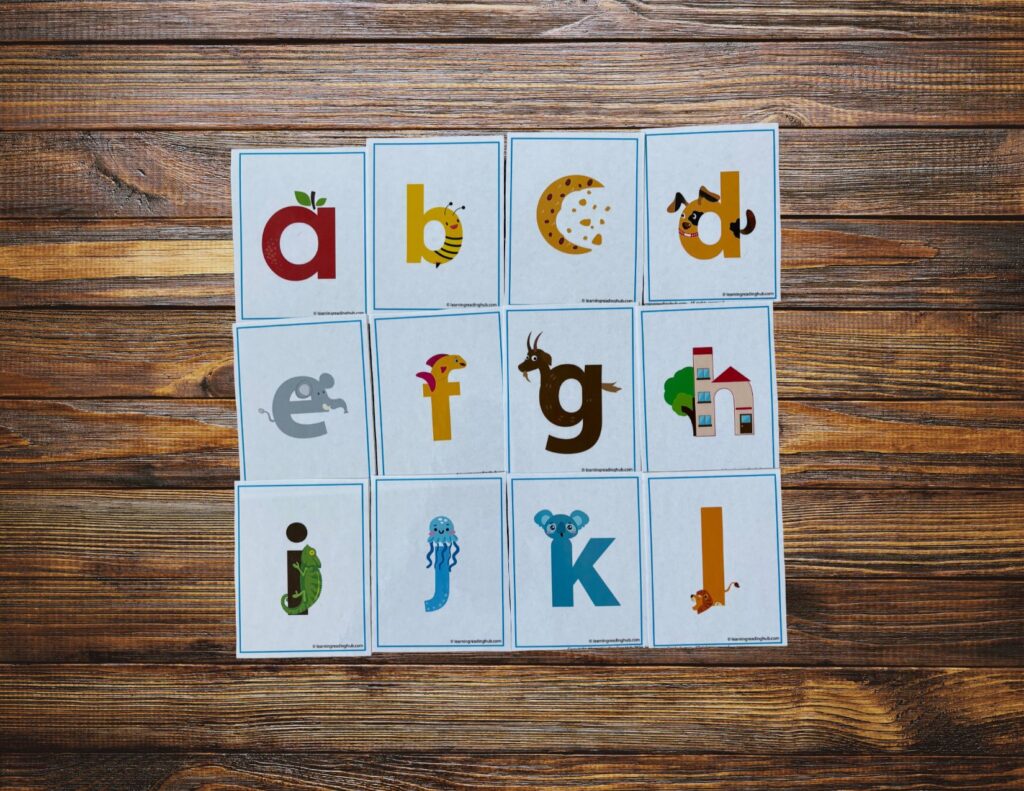
This approach makes a big difference.
Why do mnemonic alphabet cards work so well?
To understand why they work so well we have to first understand why so many children struggle to connect letter shapes with sounds. (Yes, this is an extremely common issue!)
The root cause behind many of these struggles lies here: the relationship between letters and sounds is completely arbitrary.
There’s nothing about the shape of the letters that give us a clue about their sounds!
Mnemonic cards solve this problem by adding meaning and logic to this letter shape-letter sound relationship.
Suddenly, letters make sense:
- The letter “a” looks like an… /a/ /a/ /a/ apple
- The letter “b” looks like a… /b/ /b/ /b/ bee
- The letter “c” looks like a… /k/ /k/ /k/ cookie
This is called meaningful learning, and it helps children remember letters much more easily.
Research on mnemonic flashcards found that using these mnemonic pictures help kids learn letter and sounds with fewer repetitions. Not only that, it reduces confusion and improves long-term memory!
“Embedded letters were mastered in fewer trials, were less frequently confused with other letters, were remembered better 1 week later, and facilitated performance in word reading and spelling transfer tasks compared to control letters. We suggest that embedded mnemonics better secured letters to their sounds in memory which in turn improved word learning for children in Ehri’s (2005) partial alphabetic phase.”
“Embedded Picture Mnemonics to Learn Letters”, by Adina Schmidman & Linnea Ehri
https://www.tandfonline.com/doi/abs/10.1080/10888430903117492“Integrated pictures were effective because they linked 2 otherwise unconnected items in memory. It is concluded that the shape of letters included in pictures reminded learners of previously seen pictures with those shapes whose names began with the relevant letter sounds.”
“Pictorial mnemonic for phonics,” by Ehri, L. C., Deffner, N. D., & Wilce, L. S.”Journal of Educational Psychology, 76(5), 880–893
https://psycnet.apa.org/record/1985-09174-001
Inside my course on Early Literacy Foundations, I take full advantage of this approach to help children connect letters and sounds in a clear and playful way.
This digital course works on the three pillars on early literacy: Alphabet Recognition & Letter-Sound Correspondences, Phonemic Awareness, Vocabulary Growth.
Learn more here!
I’ve also created my own set of mnemonic alphabet cards (the PhonixPals Alphabet Cards), designed with this exact purpose in mind.
Check them out here.
Tool #2: Sand Tray
The second tool is a sand tray.
The idea is very simple: a tray filled with sand where children can trace letters using their finger or a stylus. However, the benefits are huge:
- tactile learning
- fine motor development
- sensorial engagement
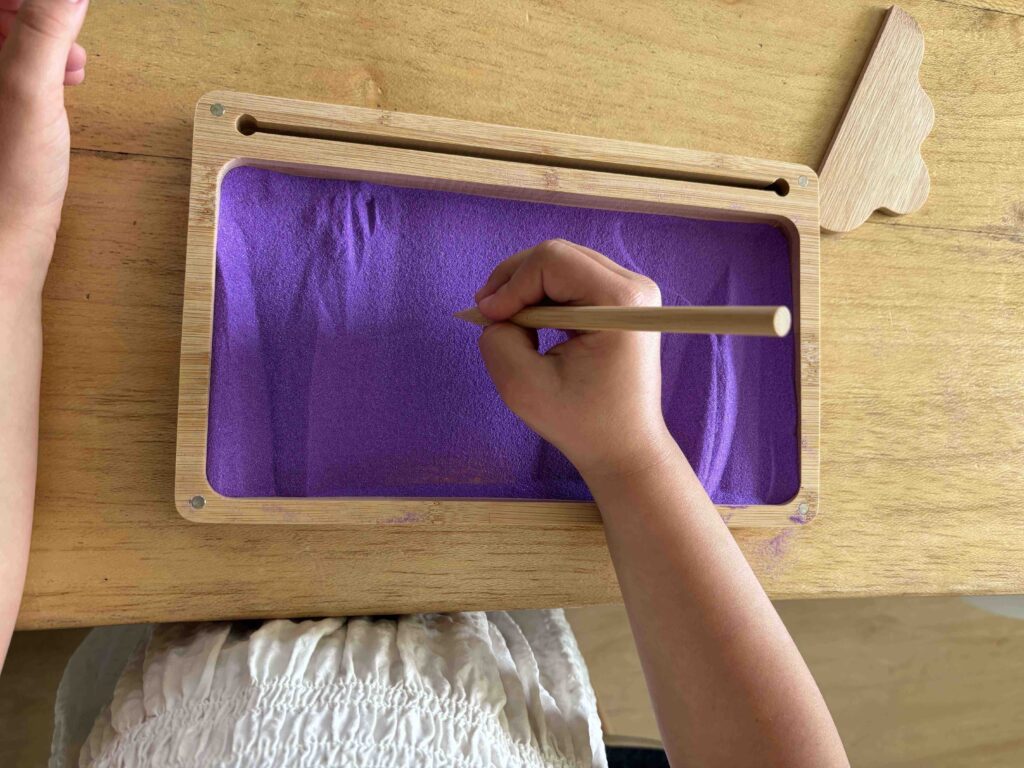
Kids tend to love sand trays because it really feels like play. And when children are focused and engaged in their “play,” this is the perfect state and the perfect time for learning.
Sand trays are very popular in Montessori education, but their use is becoming more widespread… and for good reason.
They’re also very versatile. You can use them for:
- Letters
- Numbers
- Drawing
While they are readily available on Amazon (see examples below) you don’t even need to buy one. You can easily make your own at home, if you wish!

- Wooden Sand Tray: Montessori Sand tray specifically designed for children’s education, measuring 10.2 x 6.3 inches.The set includes a solid wood tray, 2 packs of sand, wooden writing styluses, a magnetic lid, and 36 cards featuring both uppercase and lowercase letters, ready to use right out of the box
- Safe and Reliable: The tray body is crafted from high-quality hardwood, featuring a sturdy and drop-resistant structure. After meticulous polishing, its edges are smooth and free of burrs, preventing scratches during children’s play. It is suitable for young children to practice writing
- Letter Recognition and Practice: By tracing letters, numbers, and shapes on the sandy surface with a wooden stylus, children simultaneously engage their tactile, visual, and motor nerves, effectively developing their fine motor control and muscle memory for writing
- Detail Design: The deepened sand trough is ingeniously crafted to effectively prevent sand from spilling out. The tray incorporates dedicated slots for the stylus and a stand for flashcards, while the accompanying wooden leveler swiftly smooths the sand surface. Additionally, it comes with a magnetic sealing lid for convenient storage and portability
- Gift for Children: This wooden sand tray toy is perfectly suited for Montessori classrooms, preschool classrooms, and home early education settings. It’s not just a fun toy but also an early educational tool that grows with the child. It makes an ideal gift for children’s birthdays and festivals
While not 100% necessary, inside my digital course on Early Literacy Foundations, I also strongly recommend you invest in a sand tray… or you can make your own!
Tool #3: Sandpaper Letters
Another wonderful tool for learning letters is sandpaper letters.
These are simply letters cut out of sandpaper and placed on cards. See example below.
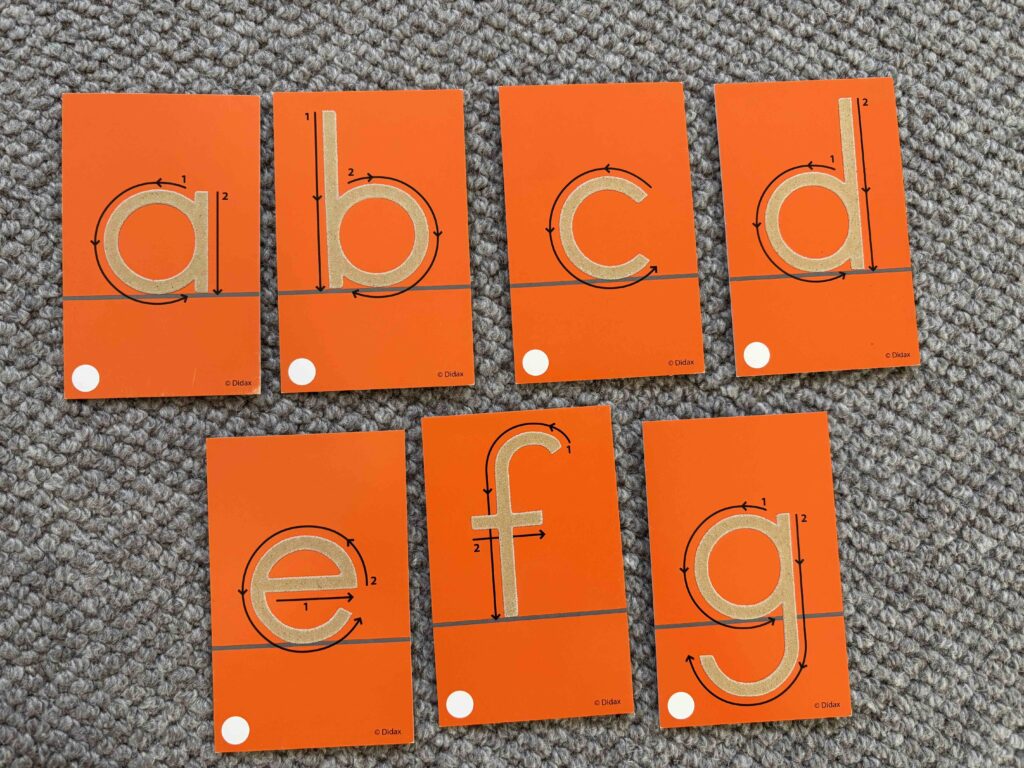
Children trace the rough letter shape with their finger while saying the sound.
This becomes a multi-sensory activity, which helps children remember letters much more easily.
Just like sand trays, sandpaper letters have been used for many years in Montessori education. This tool works really well because it combines movement touch and sound, as the idea is to finger trace the letters while saying their sounds to strengthen letter to sound connection.
There are many options available on Amazon and other retailers, both to teach uppercase and lowercase alphabet letters.
The set below is the one I have been using for lowercase. I find their size really convenient, and I appreciate they guide you for correct letter formation order.

- Kickstart your preschooler’s educational journey into reading and writing – Help young learners master the alphabet in an engaging and effective way. Designed to captivate young minds, these cards integrate sight, touch, and sound, making the learning of the alphabet not just interactive but truly enjoyable.
- Bring letters to life and unlock a world of tactile learning – Touch reinforces every letter’s shape and sound,
- Help your child grasp the fundamentals of writing with conf
- Sandpaper letters are educator developed, classroom tested, and always trusted for efficacy, durability, and authentic learning value – These cards can be used alongside other Didax manipulatives for preschoolers like sandpaper numerals which help in learning correct numeral formation.

However, if you are looking for bigger cards, for uppercase letters, cursive sandpaper letters, etc., you’ve got plenty of options. A couple more examples below.
Uppercase Sandpaper Letters

- For Grades prek-1
- Kickstart your preschooler’s educational journey into reading and writing – Help young learners master the alphabet in an engaging and effective way. Designed to captivate young minds, these cards integrate sight, touch, and sound, making the learning of the alphabet not just interactive but truly enjoyable.
- Bring letters to life and unlock a world of tactile learning – Touch reinforces every letter’s shape and sound, deepening understanding and memory retention. Each durable flash card has directional arrows and when children trace the letters with their fingers, they engage their sense of touch. This can help imprint the shape and form of the letters in their memory, paving the way for handwriting.
- Help your child grasp the fundamentals of writing with confidence and ease – Instill a love for learning and literacy from an early age. Didax sandpaper letters make learning interactive and enjoyable, which encourages curiosity and a desire to explore in the future. This product algins with the Montessori style learning, ideal for daycares. Early learning centers, homeschools and PK-2.
- Sandpaper letters are educator developed, classroom tested, and always trusted for efficacy, durability, and authentic learning value – These heavy-duty flash cards can be used alongside other Didax manipulatives like sandpaper numerals 0-20, and letters which help in learning correct alphabet letter formation.
Cursive Sandpaper Letters

- Designed for right-handed learners.
- Size of blue wooden boards: 6.25″ x 4.75″
Tool #4: Alphabet Songs
We all know songs are also an exceptional tool to learn anything (letters, numbers, colors…) in early education.
Having said that, I’m extremely picky when it comes to ABC songs, as not all of them are created equally.
People usually simply looks at these two things:
Does it sound good? Does the video look pretty?
And while those are important factors to consider (we want children to be engaged), we shouldn’t forget about the educational part!
There are some little nuances that will help us determine whether the songs are pedagogically sound… or not!
Let me share with you three common problems I usually find in alphabet songs:
- Incorrect Pronunciation of Sounds
I see (or well, hear!) this mistake over and over…
Many ABC Songs add an extra “uh” sound at the end of consonants when saying the letter sounds.
This is, indeed, a very common habit… but it’s also one that has to stop!
I am aware that this is not ill-intentioned—many people were taught the letter sounds in this way (“kuh,” “puh,” “muh) growing up, so they teach them like that to their kids too.
On the surface, it might seem like a little harmless detail, but you’ll notice that this can end up in a serious problem later on. More specifically, when your child starts blending sounds to read words.
Why? How does it become a problem?
What happens is tht many kids will add those extra “uh” sounds to the words they are attempting to read.
Want to hear an example of the problem in action? I explain it here using an example!
- Going too fast
I also feel some ABC songs move too fast, and simply don’t repeat the letter sounds enough times.
Children need time and repetition to really learn and internalize the sounds.
- Inconsistency and Incoherence
The third mistake is that many ABC songs are somewhat incoherent or inconsistent with what they teach.
Let me tell you what I mean.
For example: teaching the short /a/ sound, and using words like “acorn” or “airplane” for that sound as sample words.
It doesn’t make any sense at all! The sound the letter “a” makes in those two words is not a short /a/ sound.
I see this mistake all the time… and not only in ABC Songs! Yes, it also happens often in ABC Books and Workbooks. I’m not going to point fingers, but I’ve even seen this in quite a few best-selling materials.
Unfortunately, what this tells me is that the authors did not do enough research into the pedagogical side of the material they were producing.
No wonder children may find letter sounds so confusing!
I know, I know… I’m very picky with ABC Songs!
But this is because I see the power songs can have in early learning… and beyond! That’s why I have my own ABC Song as one of the core tools of my course “Early Literacy Mastery Course: Building Reading Foundations at Home.”
It’s not me singing, don’t worry – I had a real singer compose the song and sing it for us.
Sneak a little peak below!
Tool #5: Stories… with Intention!
Stories are another incredibly powerful way to support early literacy.
When children hear the same sound repeated in a playful, engaging story, they begin to notice patterns naturally.
This is especially powerful when stories include alliteration (the repetition of the same sound over and over, as in “Peter Piper picked a peck of pickled peppers”), rhyme and repetition.
These are some ideas of alliterative books:
- Some Smug Slug, by Pamela Duncan Edwards: A clever and beautifully illustrated picture book where almost every word starts with the /s/ sound.
- Many Marvelous Monsters, by Ed Heck: A colorful and silly book that introduces kids to monsters and new vocabulary through clever alliteration.
- The ABC Sound Book, by Laura Diaz: I may be biased because I am the author of this book, but I truly believe it’s a fantastic resource for teaching the letter sounds. This is an all-in-one book, with one alliterative story for each single letter. Fun fact: these are the stories I wrote to teach the sounds for the course mentioned earlier (Early Literacy Mastery) put together in a book. With the course, you will get them too.

Final Thoughts
Teaching the alphabet doesn’t have to be complicated.
In fact, simple tools like the ones mentioned in today’s article can make a huge difference.
Focus on building simple intentional habits, using them for:
- Meaningful connections (mnemonic cards)
- Hands-on learning (sand trays, sandpaper letters)
- Engaging repetition (songs and stories)
By doing this, you’ll be helping your child build strong foundations for reading in a natural and playful way.
Want More Support?
If you are looking for further support and for an actual roadmap to teach the alphabet to your child, check out my “Early Literacy Mastery Course: Building Reading Foundations at Home.”
I combine tools like these ones with simple routines, games, and activities that help children build early reading skills step by step.
You can also explore my mnemonic alphabet cards and other resources to support your child’s learning at home!

Hey there! I’m Laura – an author, YouTuber, blogger, and the creator of the “Learning Reading Hub” platform. I created this space to dive into the world of reading instruction and to shout from the rooftops about how vital it is to use the right methods for teaching reading. I’ve got a TEYL certification (Teaching English to Young Learners), plus a Journalism degree from the University of Navarra in Spain, along with a Master’s Degree in Communication.
I’ve always loved digging into research, jotting down my thoughts, connecting with people, and sharing what makes me tick. With a background in marketing, digital projects, and the education scene (especially language learning), I’m all about wearing different hats.
When my first kid needed to learn how to read, it opened my eyes to the challenges and complexities involved. This journey took me through a rollercoaster of self-teaching, eye-opening discoveries, and yeah, some letdowns too. There’s so much conflicting info out there, along with methods that just don’t cut it. And let’s face it, these issues are way too common.
Now, I’m all about channeling that passion (without sounding like a know-it-all!) and sharing my journey. My mission? Making it easier for those who are on the same path I once was.
My heart’s with my family and the amazing Learning Reading Hub project. I live with my husband and two little ones, raising them in a bi-lingual environment (English and Spanish).
