
I bet you already know that in English some letters are considered vowels, and others that are consonants.
But… why?
Do you know what the actual difference between a vowel and a consonant is?
And even more importantly:
Why are vowel sounds usually harder for children learning to read… and even for adults learning English as a second language?
Let’s find out!
*Affiliate Disclosure: Some links may be affiliate links. I may get a small commission at no additional cost to you, should you buy from them.
What Is the Real Difference Between Vowels and Consonants?
In English, we have five main vowel letters: a, e, i, o, u.
And sometimes “y” acts like a vowel too, in words like in gym or candy.
All the other letters (b, c, d, f, g…) are consonants.
FUN FACT: The Letter “W” Can Also Act as a Vowel!
While many people know that the letter “y” can act as a vowel, most don’t realize that the letter “w” can also function as a vowel in certain situations.
The letter “w” acts as vowels when it comes immediately after another vowel letter in a vowel team. Examples: law, few. tow.
The main difference is that the letter “w,” as opposed to “y,” only will represent a vowel sound when it’s part of a vowel team.
The Key Difference:
- Vowel sounds: Made with an open mouth and unrestricted airflow. Nothing blocks or stops the air.
- Consonant sounds: Have some kind of blockage or restriction. The lips, teeth, or tongue interfere with the airflow.
Examples of Consonant Blockage:
- /p/ → blocked by the lips
- /t/ → tongue touches the alveolar ridge (behind your front teeth)
- /s/ → air squeezed through your teeth and tongue
In other words, the main difference is:
Vowels = open airflow
Consonants = restricted airflow
Believe or not, being aware of this insight (knowing what makes a vowel a vowel, and a consonant a consonant) is key for understanding:
- Why vowels behave so differently
- Why so many children struggle with them when learning to read
- Why they can be so confusing for English Learners
Let’s dig in further to fully comprehend the implications of open airflow vs. restricted airflow!
3 Reasons Why Vowel Sounds Are So Tricky
Reason #1: Vowels Are Less Distinct
Since vowels don’t block the airflow, their sounds are less distinct, making it harder to distinguish.
In fact, if there’s no air blockage…
How are we even able to tell vowel sounds apart?
Well, we are able to tell them apart because we change our mouth shape and tongue placement.
For example:
- For the sound /a/ as in apple: our mouth is wide open, and our is tongue flat
- /e/ as in elephant: mouth slightly less open, tongue higher
Using mouth formation posters like these ones below can help your kids or students a lot.
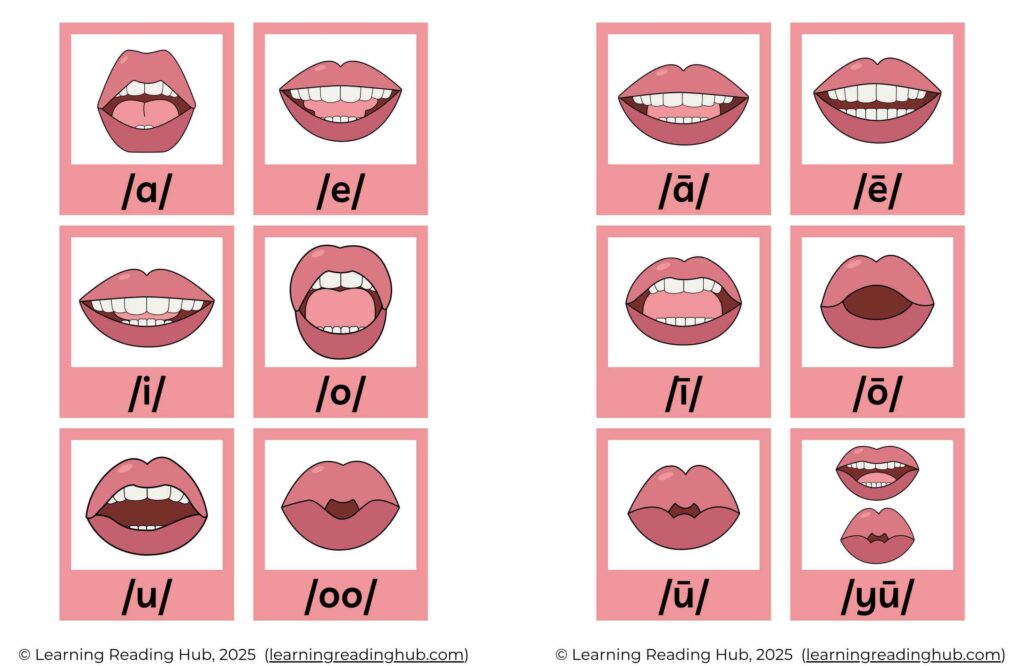
By the way, you can download these posters for free right here.
The package includes mouth formation posters for short and long vowel sounds, diphthongs, and r-controlled vowels (more on that later).
Reason #2: Some Vowels Sounds are Actually VERY Similar
Especially /i/ (as in “sit”) and /e/ (as in “set”).
They are very similar, but this is how they differ:
- /i/: tongue slightly higher, lips form a light smile
- /e/: tongue just a little lower, lips more relaxed
Hear me saying these two sounds in the audio below:
In fact, in some regions, these two sounds are pronounced exactly the same… but only sometimes!
This actually has a lot to do with the next reason…
Reason #3: Nasalization & “Glued Sounds”
Some vowels change or get distorted when they are followed by nasal consonants like /m/, /n/, or /ng/.
Can you hear a pure short /a/ sound?
Go to minute 4:42 in the video below (already pre-selected).
Watch until minute to 4:52.
Listen closely to the short /a/ sound in the words am, can, and Pam.
Is it a pure /a/ sound?
Did you notice how the /a/ sound slightly changes?
It is actually “pulled” toward the nasal sound.
These sounds are usually referred to as “glued sounds” because it feels like the vowel and the nasal sound stick together like glue!
>> If you want to learn more about glued sounds, in this other article, I go through them in further detail.
And sometimes, it goes even further…
The Pin-Pen Merger
In some parts of the U.S., the words pin and pen are pronounced the same.
This phenomenon called “The Pin-Pen Merger.” However, it doesn’t only apply to these two words!
It happens when the short vowel sounds /i/ and /e/ come before nasal sounds like /n/, /m/, or /ng/.
In those cases, in those particular regions, /i/ and /e/ will sound just the same.
So, what are those specific areas?
Take a look at the map below:

Purple areas, the merger is complete for most speakers. Note the exclusion of the New Orleans area, Southern Florida, and of the Low country of South Carolina and Georgia. There is also debate whether or not Austin, Texas, is an exclusion.
Based on Labov, Ash & Boberg (2006:68).
By the way, I am not trying to imply this is wrong!
It is natural and normal in those regions, but it can be very confusing for beginner readers and English Learners alike…
So, what can we do about all these vowel challenges?
Here are some the strategies:
7 Effective Strategies to Teach Vowel Sounds
Strategy 1: Start with the Easiest Vowels
Teaching vowels in the traditional a, e, i, o, u order is not always the best idea…
My suggestion would be to start with the easiest vowels first.
And what are those, you may be wondering…
Well, I’m so glad you asked!
A (as in apple) and O (as in octopus).
A word of caution: This may be accent-dependent. Take a look at the reference studies at the very end of the article.
Strategy #2: Don’t teach similar vowels too close together
I’m referring to the short /e/ and /i/ sounds.
As we’ve seen before, they are pretty close sounds, so I don’t think it’s a good idea to teach them too close together. Spacing them out helps prevent confusion.
Give kids time to master one before introducing the other.
Strategy #3: Use hand gestures for each vowel
This is a very powerful technique for teaching vowel sounds. It gives children an anchor movement to refer to.
These are, for instance, the hand gesture I teach for vowel sounds in my upcoming course on foundational early reading skills.
If you want to know more about the course or register your interest, do it here!
Strategy # 4: Use embedded picture alphabet cards
These are the type of alphabet cards I am talking aboutT They can be a true life-saver.
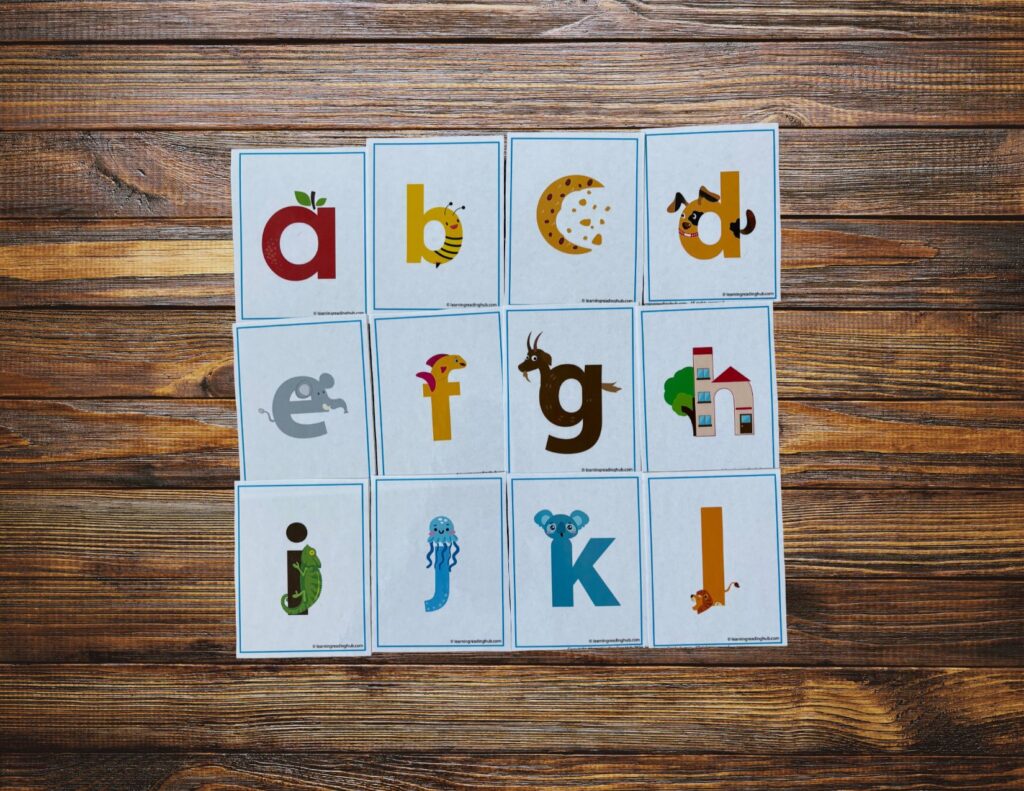
This specific set is called PhonixPals Alphabet Cards and and it’s available here for $7.99.
Embedded mnemonics is a powerful tool for learning the vowel sounds, and to learn letter sounds in general. If you wanna know more about embedded mnemonics, check out this article!
Strategy #5: Focus on mouth formation
Explain mouth position for each vowel sound, and have your students observe and experience mouth placement themselves.
You may want to support this strategy with visuals, like the free vowel formation posters we’ve seen earlier.
This strategy help students understand what their mouth should do, not just what the letter says.
You may also want to use a hand-held mirror, so children can look at their mouth as they are saying the different sounds. It’s very effective, plus it’s also likely to be a hit with your kids or students.

Strategy #6: Explain Glued and Nasalization of Sounds Only If They Come Up
You may not need to explain glued sounds, nasalization of sounds, etc. to your kid, as some children don’t notice the distortion.
In fact, in some regions, and for some English speakers, the distortion is actually really subtle. Therefore, I’m not a fan of over-complicating things for the sake of it. It’s already hard enough!
However, if your kid does notice these phenomena, and it’s confusing him/her, by all means, go ahead and explain them!
Awareness reduces frustration and confusion in these cases!
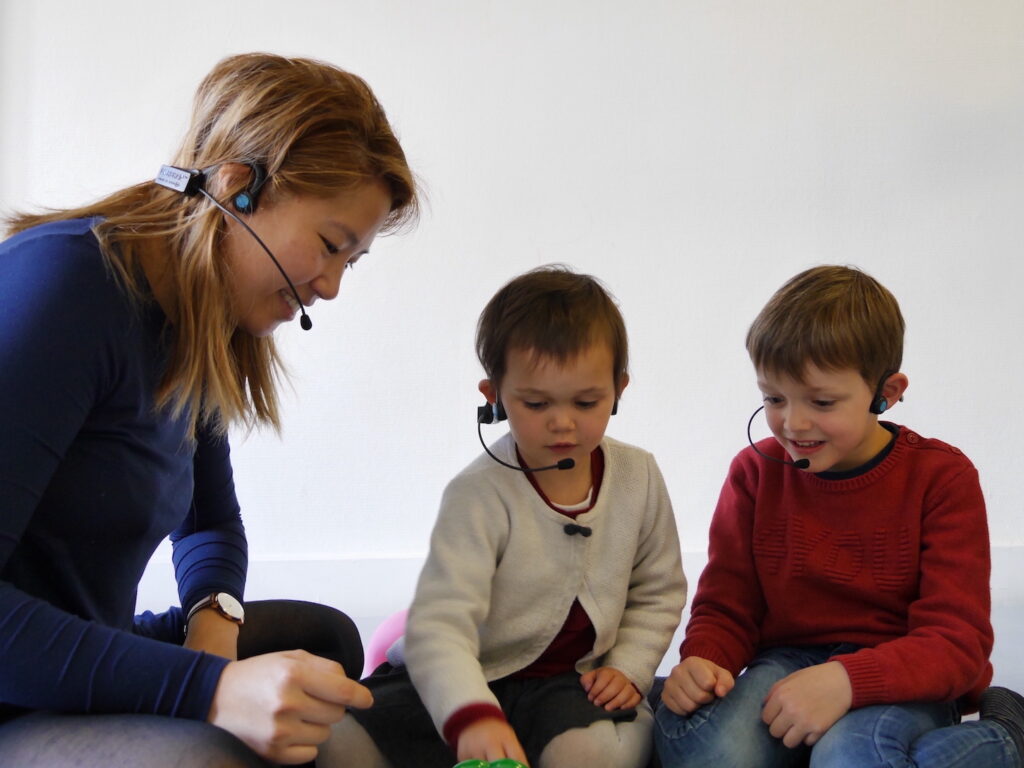
Strategy #7: Use a Bone-conduction headset Device for Clearer Auditory Feedback
This below is the bone-conduction headset I have personally used.

As you can see, it also includes a small microphone you speak into.
For children, especially those who struggle with speech or sound discrimination, this can be a very powerful tool to add to your repertoire.
Among other things, it helps kids develop sound discrimination and auditory processing skills, using their own voice.
In other words, it helps them hear tricky sounds more clearly (including vowels) and supports phonological awareness, which is a foundational skill for reading.
If you want to learn more about this device, I have an entire article talking about it here.
The device is called ForBrain, and you can get it with a 10% discount here:
Note: If the discount is not automatically applied, use code 3A9906072 at checkout
What Comes After Short Vowels?
While some of the strategies we’ve seen before can be applied to all vowel sounds, I’ve only covered the short vowel sounds specifically.
These are the ones we always start with when teaching early readers. However, bear in mind that English also has:
➤ Long vowel sounds
When the vowel “says its name,” as in make, Pete, bike, home, or cube.
➤ Vowel teams
When two vowels work together (team up) to represent one sound, like “ee” (in meet), or double oo (in moon).
➤ Diphthongs
These are complex vowel sounds that glide from one position to another, like oi in “boil” or ow in “cow.”
➤ R-controlled vowels
This is when a vowel is followed by the letter “r.” The sound of the vowel changes, and we say “it’s controlled by the vowel.” Examples: car, bird, door.
Anyway, all of that comes later!
Definitely not where we start with beginning readers. I always recommend starting with short vowels only, and one sound per letter.
Once children master those, we can build from there.
References
- US Children
An investigation of four hypotheses concerning the order by which 4-year-old children learn the alphabet letters. Laura M. Justice ∗, Khara Pence, Ryan B. Bowles1, Alice Wiggins. Early Childhood Research Quarterly 21 (2006) 374–389
https://www.researchgate.net/publication/223693238_An_investigation_of_four_hypotheses_concerning_the_order_by_which_4-year-old_children_learn_the_alphabet_letters
- Australian Children
Children’s knowledge of single- and multiple-lettergrapheme-phoneme correspondences: An exploratory studyLinda Larsena,b,c,∗, Stefan Kilian Schauberd, Saskia Kohnenb, Lyndsey Nickelsb,Genevieve McArthur. Early Childhood Research Quarterly (2020) 379 – 391
https://www.researchgate.net/publication/338717325_Children’s_knowledge_of_single-and_multiple-letter_grapheme-phoneme_correspondences_An_exploratory_study

Hey there! I’m Laura – an author, YouTuber, blogger, and the creator of the “Learning Reading Hub” platform. I created this space to dive into the world of reading instruction and to shout from the rooftops about how vital it is to use the right methods for teaching reading. I’ve got a TEYL certification (Teaching English to Young Learners), plus a Journalism degree from the University of Navarra in Spain, along with a Master’s Degree in Communication.
I’ve always loved digging into research, jotting down my thoughts, connecting with people, and sharing what makes me tick. With a background in marketing, digital projects, and the education scene (especially language learning), I’m all about wearing different hats.
When my first kid needed to learn how to read, it opened my eyes to the challenges and complexities involved. This journey took me through a rollercoaster of self-teaching, eye-opening discoveries, and yeah, some letdowns too. There’s so much conflicting info out there, along with methods that just don’t cut it. And let’s face it, these issues are way too common.
Now, I’m all about channeling that passion (without sounding like a know-it-all!) and sharing my journey. My mission? Making it easier for those who are on the same path I once was.
My heart’s with my family and the amazing Learning Reading Hub project. I live with my husband and two little ones, raising them in a bi-lingual environment (English and Spanish).
